

ADVERTISING
The Ochsenschläger family in Biblis-Wattenheim are pioneers in growing legumes
The chickpea, previously known primarily from southern countries, has now found an agricultural home in southern Hesse. The Ochsenschläger family farm in Biblis-Wattenheim is the first on the Bergstrasse to successfully cultivate the protein-rich legume – with remarkable results. District Administrator Christian Engelhardt visited the farm to learn more about the cultivation and praised the farming couple's courage: "This is true pioneering spirit. We need to find out which crops have a future in our region under the changing climatic conditions."
Rondo variety in 2024 – and it proved to be the right decision. The plants developed quickly, delivered the best yield, and were visually appealing. Now, other chickpea farms in the region are also using this variety.
Besides its culinary value as a protein-rich and versatile ingredient, the chickpea also has agroecological advantages: rhizobia bacteria on its roots bind nitrogen from the air, thus improving soil quality, which can reduce the use of artificial fertilizer.
The harvest from Biblis-Wattenheim is currently available in the farm shop, and larger quantities will soon be supplied to restaurants. Dagmar Ochsenschläger recommends soaking the dried chickpeas for twelve hours – ideally overnight – adding a little baking soda for better digestibility. After rinsing, they should be cooked for 60 to 90 minutes and salted only towards the end. Whether as hummus, in salads, curries, or baked crispy in the oven – the possibilities are endless.
The cultivation in Biblis-Wattenheim is part of the project "Here I am! – The South Hessian Chickpea" of the Southern Hessian Organic Model Region. The aim is to establish the chickpea as a regional crop. Six farms in southern Hesse are participating this year, two more than last year.
(RED/PSB)
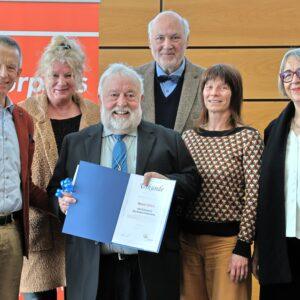
Featured image: District Administrator Christian Engelhardt (center) presents the South Hessian chickpea from Biblis, produced by Dagmar and Siegbert Ochsenschläger. Photo: PSB