


Planned consistently and safely
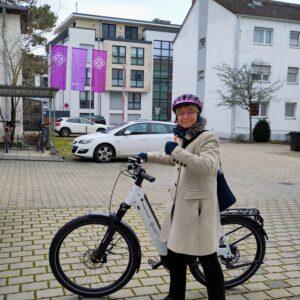
In its meeting on February 22, the city council of Darmstadt, a city of science, passed a resolution instructing the mobility office to improve the cycling infrastructure on the Herdweg cycle route (Hermannstraße/Herdweg/Theodor-Heuss-Straße/Inselstraße).
“We are examining all traffic planning options that could improve road safety on this route and make it more attractive for cyclists,” said Mayor Hanno Benz. Key aspects of this examination include analyzing intersections, traffic restrictions, road cross-sections, visibility, parking spaces (including necessary safety zones), and minimizing stopping for cyclists. In suitable sections, the feasibility of creating bicycle streets is also being investigated.
A more attractive cycle route through the neighborhoods should be designed in such a way that it does not become equally attractive to potential through traffic or rat-running. This requires consistent traffic planning and the effective use of any applicable traffic restrictions. Furthermore, connections to the main route network will be reviewed, and solutions will be developed to improve the accessibility of the secondary route and make it more visible to both cyclists and motorists.
“Cycling routes on secondary roads are serious alternatives within the overall system. A harmonious mobility situation is only possible if such a route is consistently planned with a focus on continuity and safety, leaving no gaps. Due to the anticipated impact on parked vehicles along the route, its implementation will have to be linked to parking management in the Paulusviertel district,” said Head of Mobility Paul Georg Wandrey.
The review of the Herdweg cycle route should be viewed in the context of the ongoing discussion about a cycle path on Heinrichstrasse. Without such a path, the traffic volume on Heinrichstrasse makes it unattractive for cyclists. Modifications to the intersections on Heinrichstrasse would reduce its capacity for motorized traffic. Furthermore, the narrow road width largely precludes the implementation of a satisfactory cycle path. Depending on the section, only a one-way cycle path, and in some cases no cycle path or protected bike lane at all, would be possible.
(DARMSTADT – PSD / stip)