
Just don't get upset
By W. Christian Schmitt
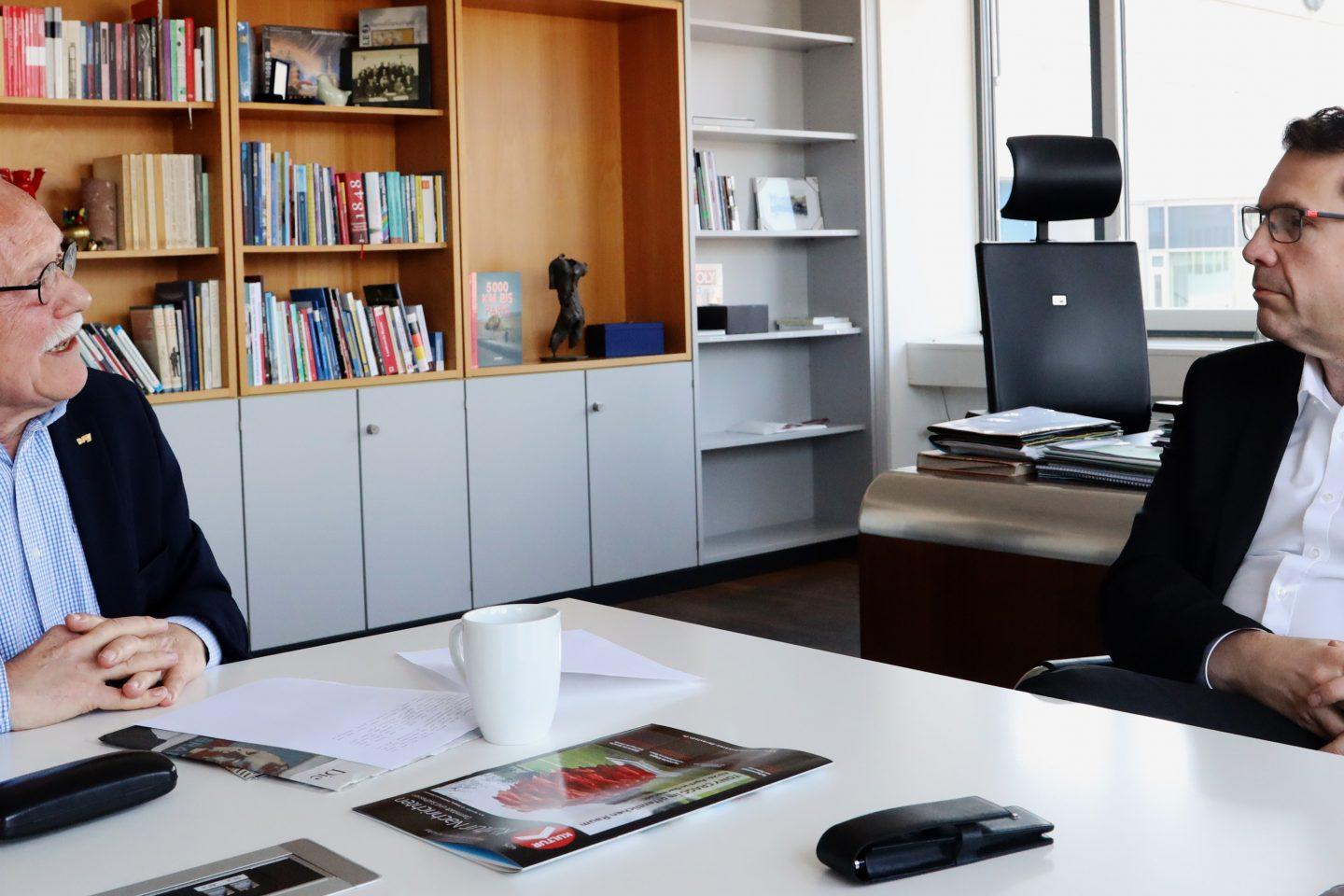
Between 1950 and 1975, the legendary "Darmstadt Talks" event series took place, aiming to bring socially and culturally relevant topics to the forefront of public discourse. The "Darmstadt Table Talks" are intended to be somewhat less focused, giving a platform to those who contribute to the preservation and development of our society in various capacities. This time, to conclude the "Darmstadt Table Talks" series, journalist and publicist W. Christian Schmitt, along with cameraman Werner Wabnitz, are guests of Darmstadt's Mayor, Hanno Benz.
Where the Hotel "Die Traube" once stood, and where a new building has filled the gap since the 1990s, the mayor's office is located on the third floor (postal address: Luisenplatz 5a). When Hanno Benz looks out of his window at the Lange Ludwig, the bustling tram and bus traffic, and all the people rushing from A to B below, he is surely one of the few local politicians who can experience Darmstadt and its citizens up close. We meet him here, and the first thing we notice on his desk is the framed saying "Nur net uffreesche" (Don't get worked up).
To begin our conversation, we ask him what it was like on election night when it became clear he would be moving into this office. What was going through his mind? Hanno Benz: "Many things, but fundamentally it was relief at such a positive result." Wasn't he afraid of all the tasks that suddenly came his way? The mayor reflects: "No, there wasn't a single moment of fear, but I did have respect for this office and the expectations of the citizens who had elected me.".
And what about today? Does he already think about everything his schedule dictates while he has breakfast each morning? In the mornings, he says, he "quite likes to go for a run, towards the sunrise," because this "contributes to mental clarity." After this reflection, my next question is: "What have you planned for your six-year term?" I listen to what he says—in his own words: "Here in Darmstadt, we've seen developments in recent years where many people felt left out. In many areas." And before I can ask any further questions, he adds: "The most important thing is how I explain political decisions to the citizens. Because politicians are obligated to the common good, not special interests." I understand, and I'm sure many other Darmstadt residents do too.
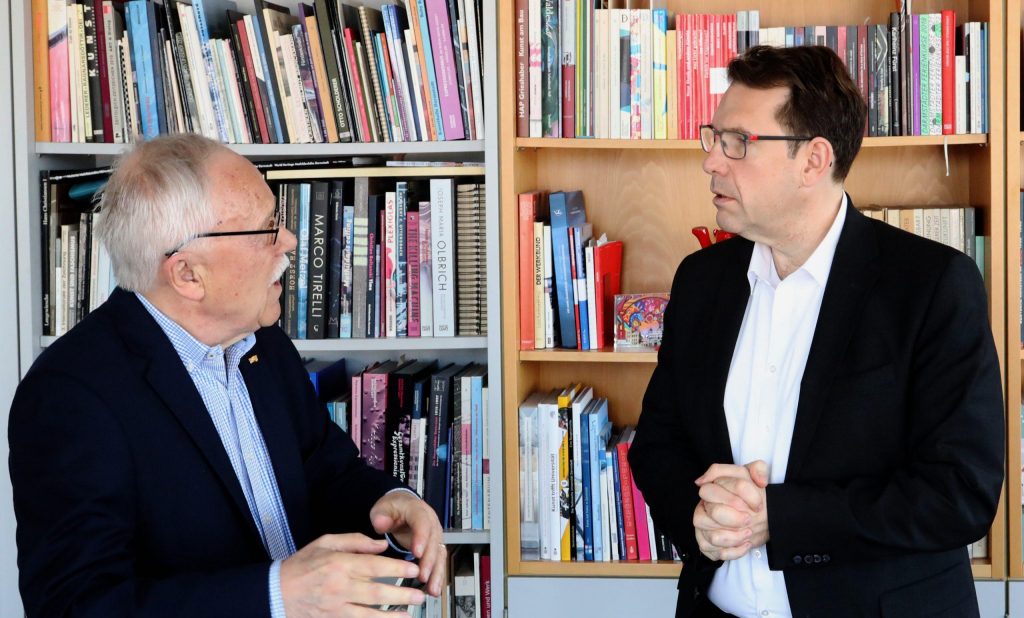
Photo: Werner Wabnitz
And then we got to talking about what is probably the most important topic, one that also interests me: the state of inner-city traffic planning. I heard Darmstadt's mayor say things like: "We want to approach the issue of traffic in such a way that all modes of transport feel taken into account. We want to tone down the confrontational approach and steer some of the decisions made in recent years back onto a sensible, practical path.".
When I asked how he intended to manage this, given that he and the SPD, which supports him, didn't have a majority in the city council and his room for maneuver was likely rather limited, the mayor replied: "I head the city council. And fundamentally, I also speak for it." He added that he had the authority to issue directives and delegate tasks. This allowed him to "certainly exert some control." Moreover, he used the option of "directly submitting his own proposals to the council." However, he then had to secure majorities for each of these proposals.
Since he drives to work every morning, he experiences firsthand what affects commuters and locals alike: 30 km/h speed limits, nonsensical traffic light sequences, traffic jams, detours, etc. And regarding transport policy, he adds: "We need to de-ideologize it, find a practical approach, and consider all road users. If there are certain groups who disagree, then so be it – and in my view, it goes against the interests of society." Pragmatic, non-ideological transport policy is "in the best interests of the community." It doesn't get much clearer than that.
And then we come to the topic of "the future of culture in this city," which once even advertised with the postmark: "The arts live in Darmstadt." We talk about all those who, for example, set nationwide standards in literature and language from this city, such as Karl Krolow, Gabriele Wohmann, Wolfgang Weyrauch, Heinrich Schirmbeck, Katja Behrens, or Georg Hensel – and I ask the mayor whom he could, or would, name today. What kind of approach does he, who traditionally also holds the office of cultural affairs officer, have to music, visual arts, or literature alike, and what is his opinion on the common saying, even among local politicians, that "culture is a voluntary service"? Hanno Benz: "I don't agree. Culture stands for diversity and social participation. Of course, in a tight budget situation, there won't be any cutbacks in culture either – but we respect the importance of culture for our city's society."
As I press the down button in the elevator, I remember that Hanno Benz – after Günther Metzger, Peter Benz and Walter Hoffmann – was already the 4th mayor I had the privilege of interviewing.
To person
Hanno Benz has been the mayor of the city of Darmstadt since 2023. Born in Darmstadt in 1972, he spent his childhood and youth in the northern district of Arheilgen, where he still lives today. After graduating from high school, he studied political science and German studies at the Johann Wolfgang Goethe University in Frankfurt am Main, earning a master's degree. Before becoming mayor, Benz worked at the intersection of politics, business, and communication, including as a senior consultant for the public sector and political communication at a renowned consulting firm in Berlin, and most recently as head of the public affairs and association management department of a municipal energy supplier in Frankfurt am Main.
With Mayor Hanno Benz, we conclude the series "Darmstadt Table Talks" after 18 episodes. Starting with the next issue of "Culture News," W. Christian Schmitt's recollections of encounters with nationally renowned figures from both social and cultural life can be found here under the title "Unforgettable.".