

“Science for All” on February 25, 2026 in hybrid format
The GSI Helmholtz Centre for Heavy Ion Research and FAIR – Facility for Antiproton and Ion Research announce that the next lecture in the "Science for All" series will take place on Wednesday, February 25, 2026, at 2:00 p.m. The event will be offered in a hybrid format and can be followed both on campus and online.
Under the title "Two values – one universe: Discrepancies in the determination of the Hubble constant", Dr. Andreas Flörs talks about one of the most exciting topics in modern cosmology.
Supernovae as a cosmic measuring tape
The lecture will focus on so-called core-collapse supernovae – enormous stellar explosions that can be used as a "cosmic measuring tape" for determining distances in the universe. Using new modeling methods, their light can be used to determine the Hubble constant independently.
This is intended to clarify open questions about the expansion rate of the universe. The so-called Hubble constant describes how fast the universe is expanding – a central topic in current astrophysical research.

About the person: Dr. Andreas Flörs
Andreas Flörs studied physics at the Technical University of Munich and graduated in 2017. He began his doctoral studies at the Max Planck Institute for Astrophysics in Garching near Munich. During this time, he worked for two years at the European Southern Observatory and participated in the observation campaign of the first neutron star merger.
For his doctoral thesis, completed in 2020, he received the Kippenhahn Prize from the Max Planck Institute for Astrophysics. Since 2019, he has contributed to the development of radiative transfer models in the adH0cc cosmology program, which has published an independent measurement of the expansion rate of the universe. Since 2021, he has been working at GSI and FAIR on computer models of the structure of heavy atoms and on radiative transfer simulations for kilonovae and supernovae.
(DARMSTADT – RED/GSI)
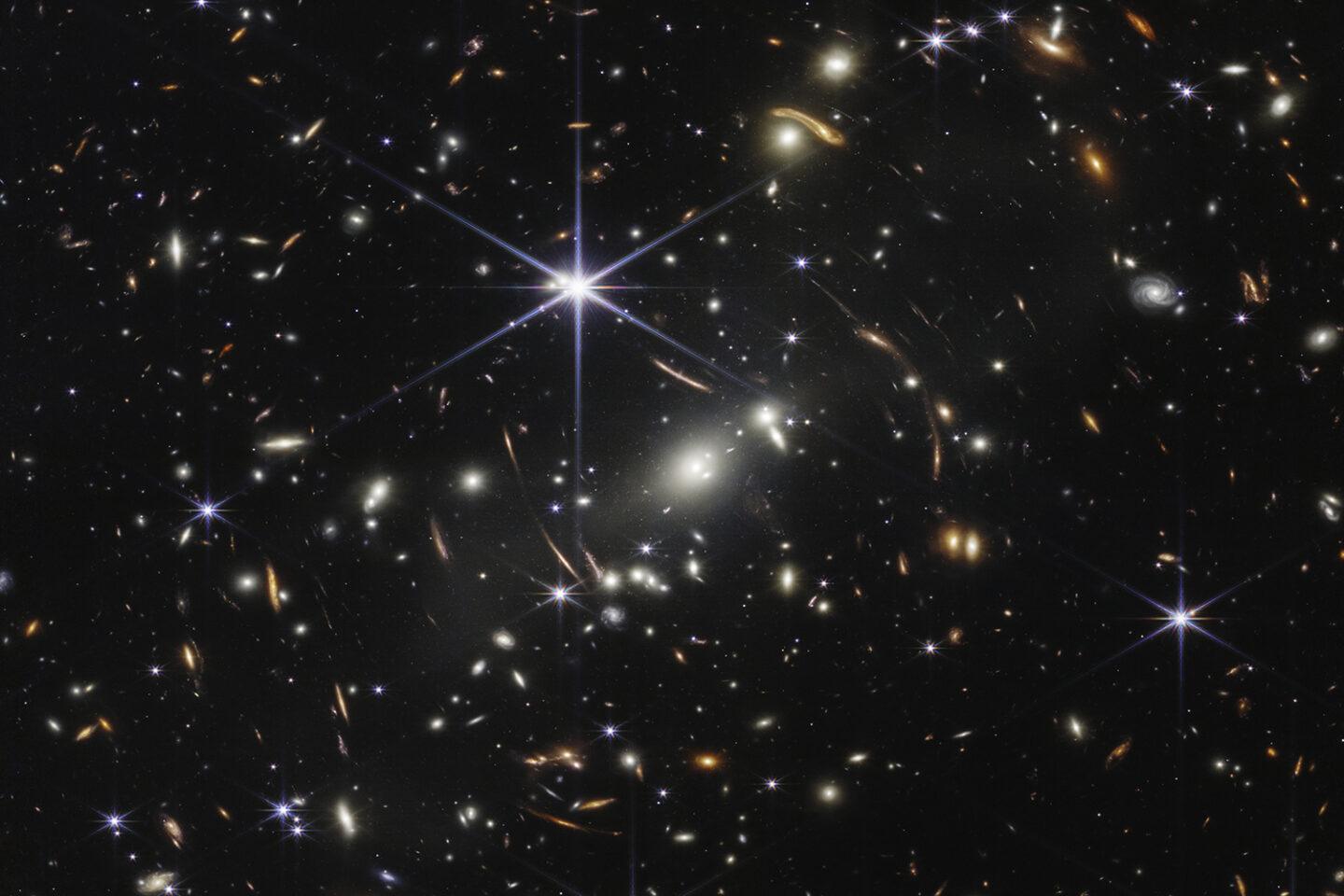
Featured image: James Webb Space Telescope image providing a glimpse into the early universe. Photo: NASA, ESA, CSA, and STScI