

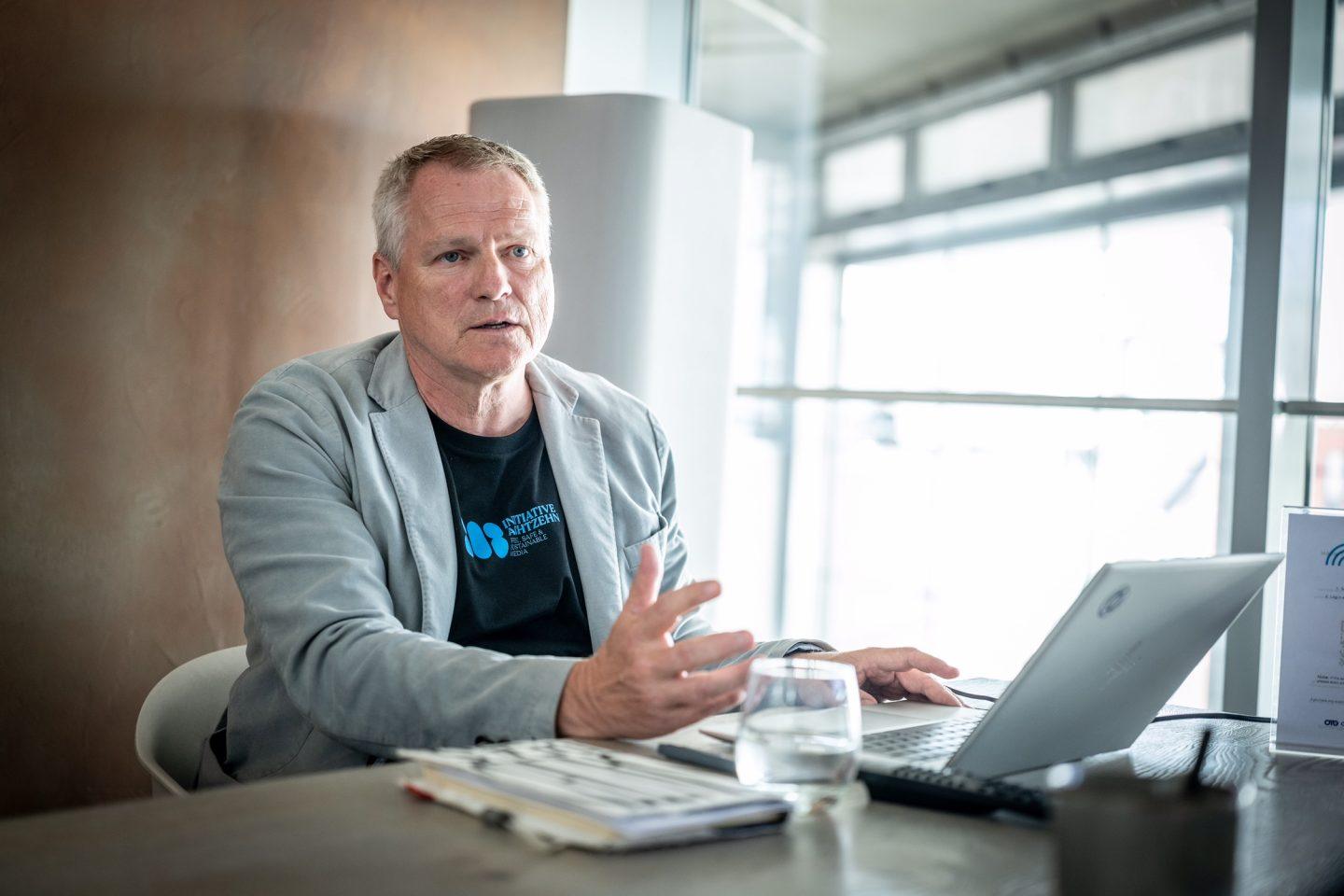
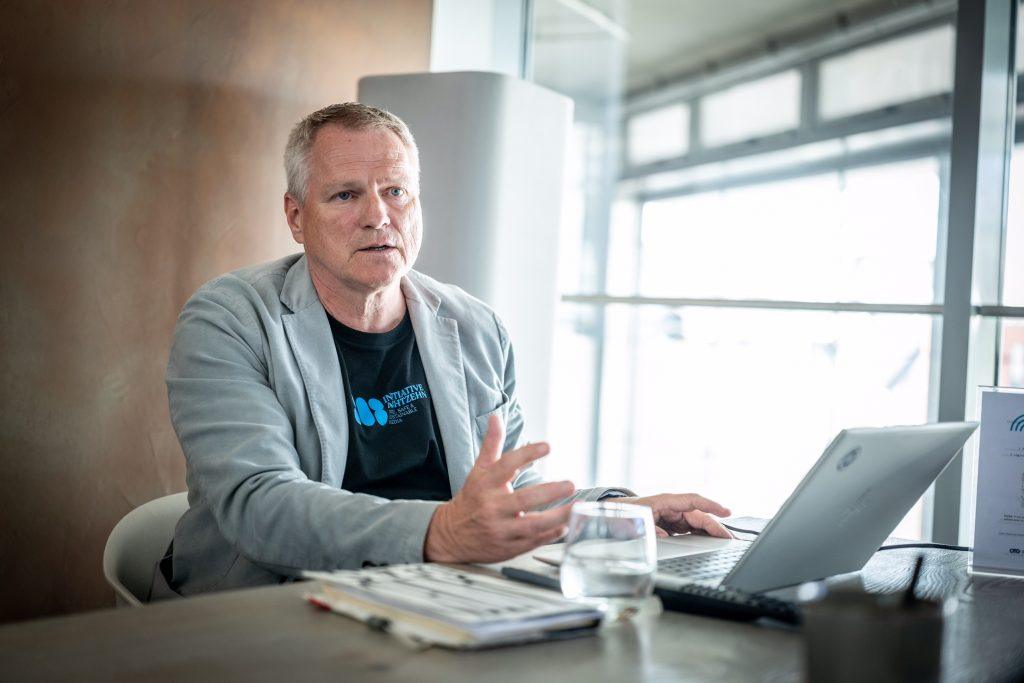
Co-founder Manfred Kluge explains the importance of free and independent media for democracy in an interview with DA.news.
Manfred Kluge has worked in media and marketing for over 35 years and is Chairman for Germany, Austria, and Switzerland (DA-CH) of the global Omnicom Media Group. Preserving media diversity with trustworthy content is a cause close to his heart. That's why he is a co-founder of Initiative 18, an association of committed and well-known individuals from the media industry, journalism, and research who have made it their mission to preserve and strengthen media diversity and independence (more information below). The United Nations' 2030 Agenda, with its 17 Sustainable Development Goals, is a global plan to promote sustainable peace and prosperity and to protect our planet. Initiative 18 calls for the inclusion of free, safe, and sustainable media as the 18th Sustainable Development Goal of the UN's 2030 Agenda.
Ulrich Diehl, who, as a Darmstadt-based publisher and editor of various newspapers and magazines in the South Hesse region and operator of the multilingual news platform www.DA.news, has made media diversity his life's work, was able to speak with Manfred Kluge, the chairman and co-founder of Initiative 18:
Diehl: Mr. Kluge, what motivated you to found Initiative 18 a year ago?
Kluge: Since the publication of the 17 Sustainable Development Goals in 2015, we have observed two serious problems. Firstly, the flood of harmful content, such as disinformation, extremism, and hate speech, which is primarily spread via social media. According to the World Economic Forum, disinformation is now the greatest global risk in the short term.
Why? Because it leads to the polarization and division of our society, strengthens autocratic tendencies, and curtails human rights. Secondly, we are witnessing the erosion of democracy on the internet, as just a few global platforms now control the vast majority of internet usage in Germany and internationally. These platforms use opaque algorithms to determine content distribution, undermine journalistic standards, and strive for further profit maximization. This combination threatens media diversity and, consequently, journalistic media outlets, as advertising revenue is excessively allocated to these platforms. This depleted budget is then unavailable for funding editorial departments, resulting in significant staff reductions in these departments for some time now.
Diehl: Has Initiative 18 been able to achieve anything to preserve media diversity since its founding a year ago?
Kluge: We have contributed to significantly increasing the attention given to the relevance of media diversity and trustworthy content, not least through our campaign "Freedom Needs the Whole Picture. Media Diversity Protects Democracy," which has been running since September. Furthermore, we were involved in contributing crucial content to the coalition agreement, as our government, for the first time, committed to strengthening media diversity, declared its intention to combat disinformation, and pledged to create fair and supportive regulations for the continued existence of the dual press and broadcasting system. We have also made our mark internationally through presentations at the World News Media Congress in Krakow and the M20 Summit in Johannesburg. Several projects are currently underway, addressing three key target groups: policymakers, media companies, and advertisers. In addition, we are engaged in dialogue with the UN and UNESCO.
Diehl: In Germany, however, the media's claims are still clearly defined. Daily newspaper publishers, in particular, continue to have no interest in competition and thus in media diversity. Their own advertising supplements often serve merely as inserts and must not be allowed to jeopardize their subscription titles with overly high-quality editorial content. But these subscription titles only reach those who can afford the expensive subscription.
Kluge: Due to the current economic conditions and the media transformation, there is certainly fierce competition in our media landscape.
And yes, subscription titles have become very expensive, but with Initiative 18, for example, we are working to ensure that these subscription costs can be claimed as tax-deductible educational expenses. The media needs good and independent editorial teams; otherwise, our democracy is in danger.
Diehl: In February, we www.DA.news as Germany's first multilingual, regional, and free internet platform. The platform can be used without access restrictions. This is very easy thanks to AI and reaches target groups that were previously untapped.
Kluge: That's fascinating, and I'm delighted by your commitment to preserving media diversity. Journalism needs to fundamentally evolve across various topics. It needs to reconnect with people, acting as a seismograph for what moves them. And then it needs to offer solutions, make them public, and empower people to become more self-reliant. This also includes presenting content in a multimedia and multilingual format to spark interest across all age groups.
Diehl: Mr. Kluge, thank you very much for your time and the detailed conversation!
What is Initiative18?
Initiative18 is an association of experts from the media industry, journalism, advertising, research, and other fields. They are united by their concern about the increasing weakening of democratic structures worldwide – and by their conviction that , and diverse media are essential for protecting democracies.
The initiative therefore calls for the United Nations an 18th goal 17 Sustainable Development Goals (SDGs) :
“Free, safe and sustainable media” as a cornerstone of democracy, human rights and sustainable development.
Why an 18th sustainability goal?
The 2030 Agenda aims to promote peace, prosperity, and justice worldwide. However, these goals can hardly be achieved without reliable information, independent journalism, and media diversity.
Initiative18 points out that:
- Media inform the public, uncover abuses and facilitate debate.
- Freedom of the press is threatened in many places – by violence, political interference, disinformation or economic pressure.
- Sustainable development can only succeed if people have access to safe, verified and trustworthy information.
Therefore, the initiative advocates for the official recognition of media freedom and media diversity as a global priority.
What Initiative18 stands for
The initiative pursues a clear mission:
Media must be able to operate freely, safely and sustainably – to protect democracy and human rights.
Their main concerns are:
- Protection of journalists through strong laws and consistent enforcement.
- Preserving media diversity , for example through fair business models and sustainable advertising financing.
- Combating disinformation through platform responsibility and modern technologies.
- Strengthening media literacy in all age groups.
- Transparent and ethical use of technology and data.
- Fair framework conditions in the media and advertising market – from data protection to competition to the remuneration of journalistic services.
- Value-based advertising decisions that support high-quality content.
All these points are intended to contribute to creating a healthy media ecosystem that keeps democratic societies stable.
How does the initiative intend to achieve these goals?
Initiative18 is building a broad alliance of companies, associations, and social actors . Together they want to:
- to draw political attention to the issue,
- Promote media diversity and quality journalism,
- supporting responsible advertising decisions,
- take action against anti-democratic content,
- Strengthen media literacy and improve journalistic working conditions.
The goal is to establish a media system that is transparent, secure, pluralistic and future-proof.
Who is behind the initiative?
The initiative is supported by people who have worked in and with the media system for many years: from journalism, media economics, advertising, science and various related fields.
They all have one thing in common:
- the commitment to democracy,
- the belief in the positive benefits of technology,
- the will to pass on knowledge,
- and the conviction that transparency and media diversity are prerequisites for freedom.
The guiding principle is:
"Freedom needs the whole picture. Media diversity protects democracy."