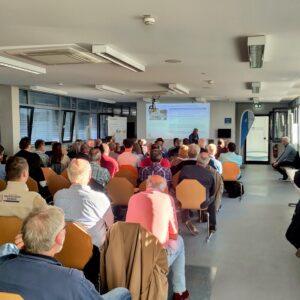



Forward-looking target network planning by e-netz Südhessen ensures that supply infrastructure will remain reliable and efficient in the future
As part of the energy transition, distribution network operators must design and develop their electricity grids to meet new requirements and ensure a consistently stable supply. The entire energy supply system is undergoing a transformation: Increasingly, decentralized generation plants, such as photovoltaic and wind power plants, as well as new consumers like charging stations and heat pumps, must be reliably connected to the grid. To determine today what a reliable and efficient grid infrastructure must look like, e-netz Südhessen utilizes the strategic tool of target grid planning.
e-netz Südhessen prepared for this challenge early on. With its Network Development department, the ENTEGA subsidiary has its own team of experts who develop realistic scenarios for future network development at the low and medium voltage levels. Based on these scenarios, well-founded renewal and expansion concepts for optimally dimensioned networks are created. Cost-efficiency and sustainability are key priorities – the calculated expansion and upgrade requirements always follow the guiding principle of "as much as necessary, as little as possible." This department also provides e-netz Südhessen with important flexibility in its target network planning. Target grid concepts can be adapted independently and at short notice if, for example, technological innovations, political decisions, and market developments related to the energy transition change the framework conditions: “The basis for target grid planning is our scenario framework, which is broken down regionally to the local grid level. This framework describes two different development paths, showing how the framework conditions for grid planning could develop over the next 25 years based on current knowledge. The scenario framework is updated every two years, and also event-driven in the event of major changes in the political or market framework conditions,” says Dr. Helge Pluntke, Head of Grid Development at e-netz Südhessen.
Digitalization plays a key role in target network planning. As one of only a few distribution network operators in Germany, e-netz Südhessen uses digital, computational network models from the medium-voltage level down to the low-voltage level. This allows for the efficient evaluation of new grid connections for consumers and generation plants, as well as the development of forward-looking and demand-oriented target network concepts based on simulation models. "This requires considering the long-term use of our operating resources, the integration of decentralized renewable energy generation, storage technologies, smart grids, and electromobility. The result is a systemic target network plan that makes a crucial contribution to the success of the energy transition," says Dr. Pluntke.
Municipal target concepts are derived from the overarching overall concept for the e-netz Südhessen network area. This ensures the best possible efficiency for the entire infrastructure in the region and all municipal network areas. Target network planning helps to efficiently integrate renewable energy generation plants into the local grid, thus supporting the transition to a more sustainable energy supply in southern Hesse.
(ENTEGA ADVERTISING)