
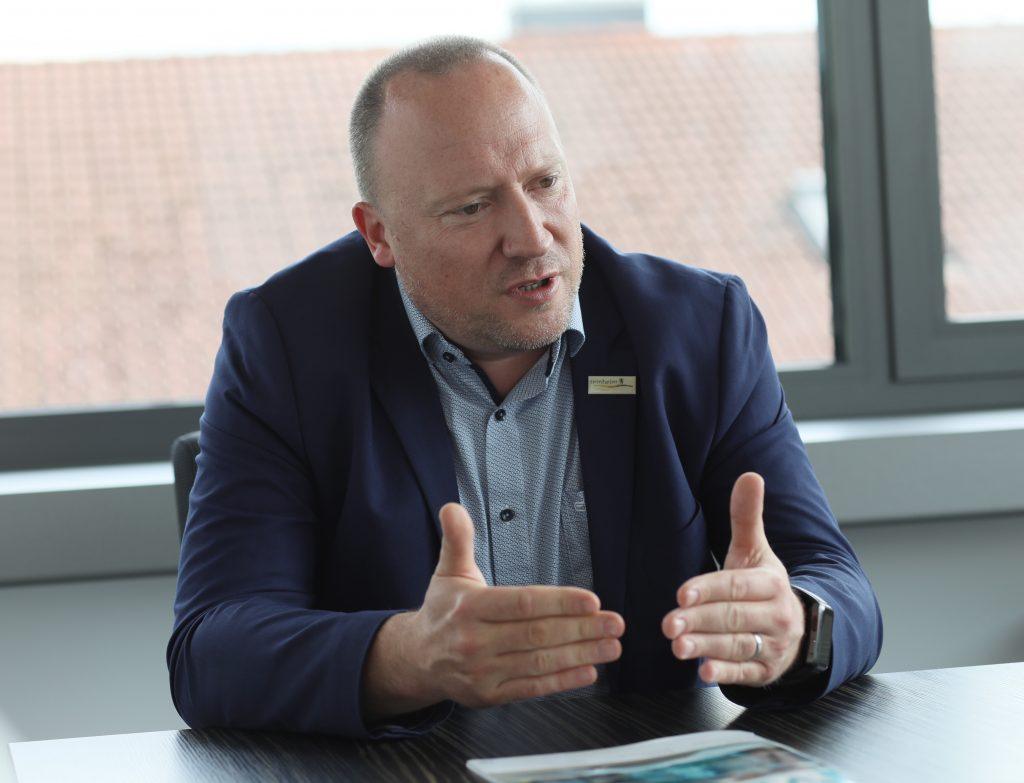
Manuel Feick is an approachable mayor: down-to-earth, open, and direct. He has been at the helm of the town of Reinheim since 2019 and was recently re-elected with overwhelming support. The trained public administrator was previously active in local politics in Messel and Modautal, among other places, before being elected First Deputy Mayor of Reinheim in 2016. He is a mayor with a great deal of passion and a clear commitment to making politics more accessible to the people.
In the interview, Feick talks about his motivation, why social security and climate protection are central issues for him – and how Reinheim is reacting to the departure of the large company MERZ. He also offers very personal insights: what is truly important to him, which values guide him – and why a schnitzel with Kochkäse cheese means more to him than oysters and golf courses.
Mr. Feick, you are a popular mayor in your city – as your recent re-election has shown. What distinguishes you from your counterparts in other towns and municipalities? What do you perhaps do a little differently?
I had excellent mentors in former district administrators Alfred Jakoubek and Klaus-Peter Schellhaas. They taught me how important transparent communication with citizens is – especially when it comes to unpopular decisions. It's particularly important to engage people who don't immediately understand the decisions. You have to take the time to listen to them. Equally crucial is how you manage social media: if you don't actively use it yourself, others will target you. I handle all of this myself – I respond personally. Open communication on equal terms is extremely important to me.
Let's get to know Manuel Feick a little better: What are your hobbies? What food wins you over? And what values are particularly important to you?
I would describe myself as a sociable and pleasure-loving person who is very down-to-earth and feels a deep connection to my homeland. I much prefer a Kochkäse schnitzel to oysters, and I'd rather go bowling than golfing – though that's not meant to be disrespectful to golfers. I'm reliable and always have a listening ear for everyone.
Let's turn to city politics: Reinheim – like many municipalities – faces financial and structural challenges. Where do you see potential for savings, and where would you like to invest despite tight budgets?
Of course, like all municipalities, we are under financial pressure. We face factors that are largely beyond our control – such as inflation, municipal revenue sharing, and rising wage and energy costs. Added to this are legal requirements, for example, regarding after-school childcare. This is mandatory, but it generates deficits because we don't receive sufficient support from the state.
Our approach to the budget is very careful: We plan every investment – regardless of its size – meticulously and always ask ourselves: How will this be financed? After all, that's how it's done in our personal lives.
Despite all the challenges, we continue to set clear priorities – for example, strengthening support for children, families, and senior citizens, as well as civil protection. Social security is very important to me, as are maintaining and improving infrastructure, energy-efficient renovations, and climate protection. These are areas where cuts must not be made.
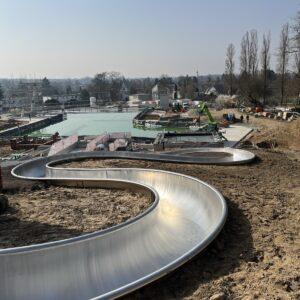
Our fundamental goal is to avoid taking on any new debt. Reinheim is a vibrant and welcoming town with a lively community life and attractive leisure facilities – such as our outdoor swimming pool. Furthermore, we have one of the lowest property tax rates in the district.
Is there any news regarding MERZ? How can this important employer and business tax payer be adequately replaced – are there already plans?
At the beginning of the process was the question of whether the city could accept the property from MERZ – the company gifted it to us for redevelopment. This involved, among other things, the issue of gift tax and whether the city was even permitted to accept such a gift. Now that these legal questions have been resolved, the land donation is on the agenda for the next city council meeting, and I hope it will be approved.
In addition, we intend to acquire an adjacent area extending to the "Sonnenhof" complex, allowing us to develop a total of 80,000 square meters. We have clear ideas about the types of businesses we want to attract there – a professional service provider is handling the approach to potential investors for us. This provider is also in contact with larger companies. Throughout all of this, we must always keep in mind: How will we compensate for the loss of approximately 300 jobs and around two million euros in business tax revenue?
In many cities, politics, commerce, and associations tend to work independently – in Reinheim, this seems to be different, for example with the "Reinheim Market". What do you think is the reason for this?
I believe this is primarily due to the respectful cooperation between the institutions, the business association, and the municipal organizations. We interact as equals and share the goal of strengthening businesses and keeping them in Reinheim. Mutual needs and challenges are taken seriously. Economic development is one of my key political priorities.
Reinheim, like Pfungstadt, is twinned with a suburb of Bordeaux. Is this town twinning still active? And is there perhaps a nice or funny anecdote about it?
The partnership with the French town of Cestas is also very important to me personally. While our twinning association is a bit long in the tooth, it continues to do fantastic work. The reciprocal visits – for example, between the fire brigades – and the active youth exchanges, such as in youth football, are particularly noteworthy. There are even joint WhatsApp groups. I can say with conviction: this partnership is thriving.
Finally, let's return to you personally: What motivated you to run for mayor? And what legacy do you hope to leave behind in Reinheim after your term in office?
I never planned to become mayor. A series of coincidences led to it. After stints in local politics in Messel and the Modau Valley, I moved to Reinheim, became First City Councillor – and met very competent and supportive people who encouraged me and stood behind me. They weren't "traps."
Today I can say: This is my dream job. I can shape things, have an impact, and actively solve problems. I hope that the people of Reinheim will grow even closer, that a genuine sense of community will develop – with dialogue instead of talking behind each other's backs. For the good of our city and our community.