

Focus on the carbonization plant of the science city
The newly published book "Terra Preta. Biochar, Effective Microorganisms & Co." also presents the carbonization plant in the science city of Darmstadt. A twelve-page article illuminates the concept and planning of the plant, where biochar is produced for sustainable land use and climate protection.
Terra Preta – a particularly fertile black soil from the Amazon region – was used around 500 years ago and scientifically studied in the 19th century. Its key component is biochar, which promotes soil structure, water retention, and carbon sequestration.
Production in Kranichstein since 2021
The Darmstadt carbonization plant was built next to the existing composting facility in Kranichstein. Planning began in 2019, and the Darmstadt Municipal Services and Operations Department (EAD) commissioned the plant in 2021. Since then, biochar has been produced there, which is used, among other things, in urban green spaces such as in the Lincoln housing estate and at the Vivarium Darmstadt Zoo. The development of so-called "Darmstadt soil" followed in 2024.
According to the city, the project serves to close biomass cycles and prepare the municipality for climate change.
Practical tips from tiled stoves to industrial plants
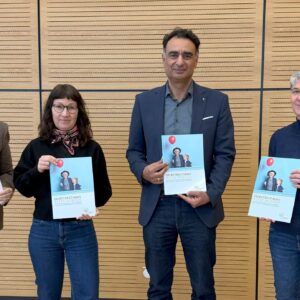
The book was published by the Kraichgau Local History Society in cooperation with the ProCarbo Association. The authors are Reiner Dick and Susanne Kaiser-Asoronye. The work is aimed at anyone interested in combining soil regeneration, climate protection, and the circular economy. It describes methods of producing biochar – from wood-burning stoves to industrial plants – and provides practical advice on its application.
The book is available, among other places, at the Darmstadt composting facility and in the Vivarium's zoo shop for 16 euros.
(DARMSTADT – RED/PSD/dk)