ADVERTISING
She never met Fidel Castro in person
Between 1950 and 1975, the legendary "Darmstadt Talks" event series took place. In short, its aim was to bring culturally interested citizens closer to relevant topics and issues through public discussions. This is also the goal of the "Darmstadt Table Talks," where those who contribute to the preservation and further development of our society in various capacities have their say. This time, journalist and publicist W. Christian Schmitt, along with cameraman Werner Wabnitz, are guests of novelist Barbara Zeizinger, who lives in Darmstadt-Eberstadt.
She says she's not a "travel writer," even though Wikipedia says so. She only ever wrote one guidebook about Cuba, back when Fidel Castro was still alive and you couldn't escape his image (along with revolutionary slogans) on every street corner in Havana. She prefers to be seen as a poet, though, because she "came to writing through poetry." Several of her small poetry collections, including "If I Had Stayed" and "Wide Angle Close," have been published by the Ludwigsburg-based Pop Verlag.
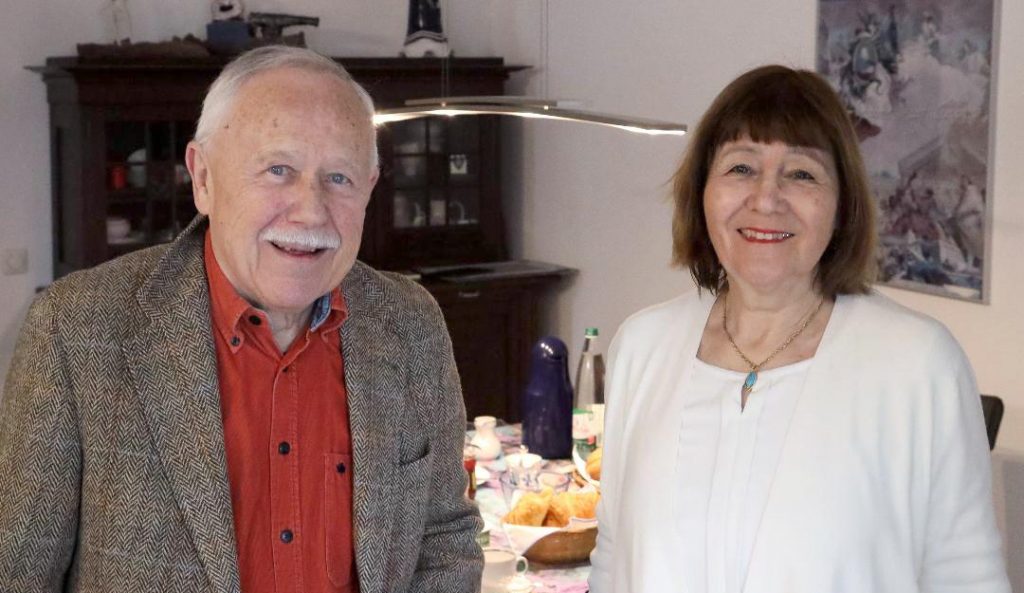
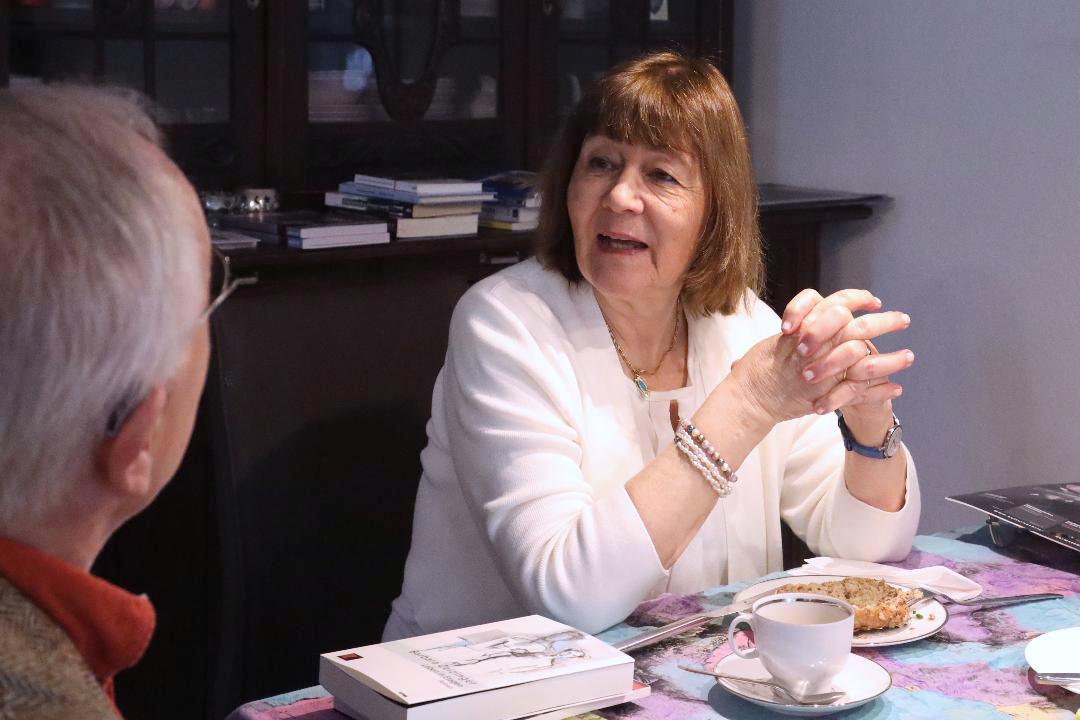
Photo: Werner Wabnitz
To be precise: Barbara Zeizinger is a novelist, as she proves once again with her latest publication, "Life on Floors." The book's blurb states: "Barbara Zeizinger tells the story of a house and its inhabitants between 1931 and 2020." Furthermore: "It's about four families navigating the era of National Socialism, war, the post-war period, reconstruction, and the democratic development of the Federal Republic of Germany..." And she adds: "Almost all my books are family novels and have a historical backdrop..."
But we wanted to talk less about the book's content and more about the author: how she got into writing, how a book comes about for her, how much time she invests in it, what she experiences at readings, how large her fan base has become, what her life and writing plans look like, and much more. Barbara, as I may call her, was a teacher at the Bergstraße school complex for almost 40 years, trying to instill in her students what is called "maturity," including historical awareness and social skills.
We sit across from each other in her living room. She has prepared breakfast. I butter a roll and enjoy my coffee before we continue our conversation. "How did you actually get into writing?" I ask. "I didn't feel that I absolutely had to become a writer; I'm a late bloomer and was already in my late forties when I published my first book," she says, "but I've always enjoyed writing." In her younger years, she even wrote articles for the Mannheimer Morgen newspaper. Back then, she recalls, her focus was on all the topics "that others didn't want to cover." And so she wrote "about miniature golf, the hairdressers' guild, carnival sessions, regular pub gatherings, but also about films that others didn't want to see."
Where did her inclination towards journalism come from? Because her father was once editor-in-chief of the Odenwald newspaper. Despite all this, she didn't become a journalist, but first a teacher and later a writer who can boast that she is a member of, among other things, the PEN Club, the Darmstadt writers' group Poseidon, and the Kogge literary society.
She too grew up as a student listening to singer-songwriters like Hannes Wader, Dieter Süverkrüp, and others. "My very first novel," she recounts, "was set in Italy and dealt with hostages and their execution." A novel that required extensive on-site research. Today she knows that her "writing time is limited" and that she can't "write from morning till night.".
As our conversation at the table drew to a close, she told me that she was "ambitious when it came to writing." I asked what was truly essential, especially as one gets older. "Friendships and being with people are important," she confided. Because this, she explained, was "good for broadening one's perspective." And then she added, "I feel free to write what's important to me.".
Since she has proven that she can do both, writing newspaper articles and books, I ask her one last question: does she also believe that journalists are (more) responsible for informing and writers (more) for entertaining? She smiles.
About
Barbara Zeizinger: Born in 1949 in Weinheim, she lives in Darmstadt. She studied German, History, and Italian in Mannheim and Frankfurt. She is married and has two daughters. Further information can be found at www.barbarazeizinger.de
Our next interviewee is Andreas Roß, a crime novelist from Darmstadt.