

The city plans to fundamentally restructure mediation at Mathildenhöhe
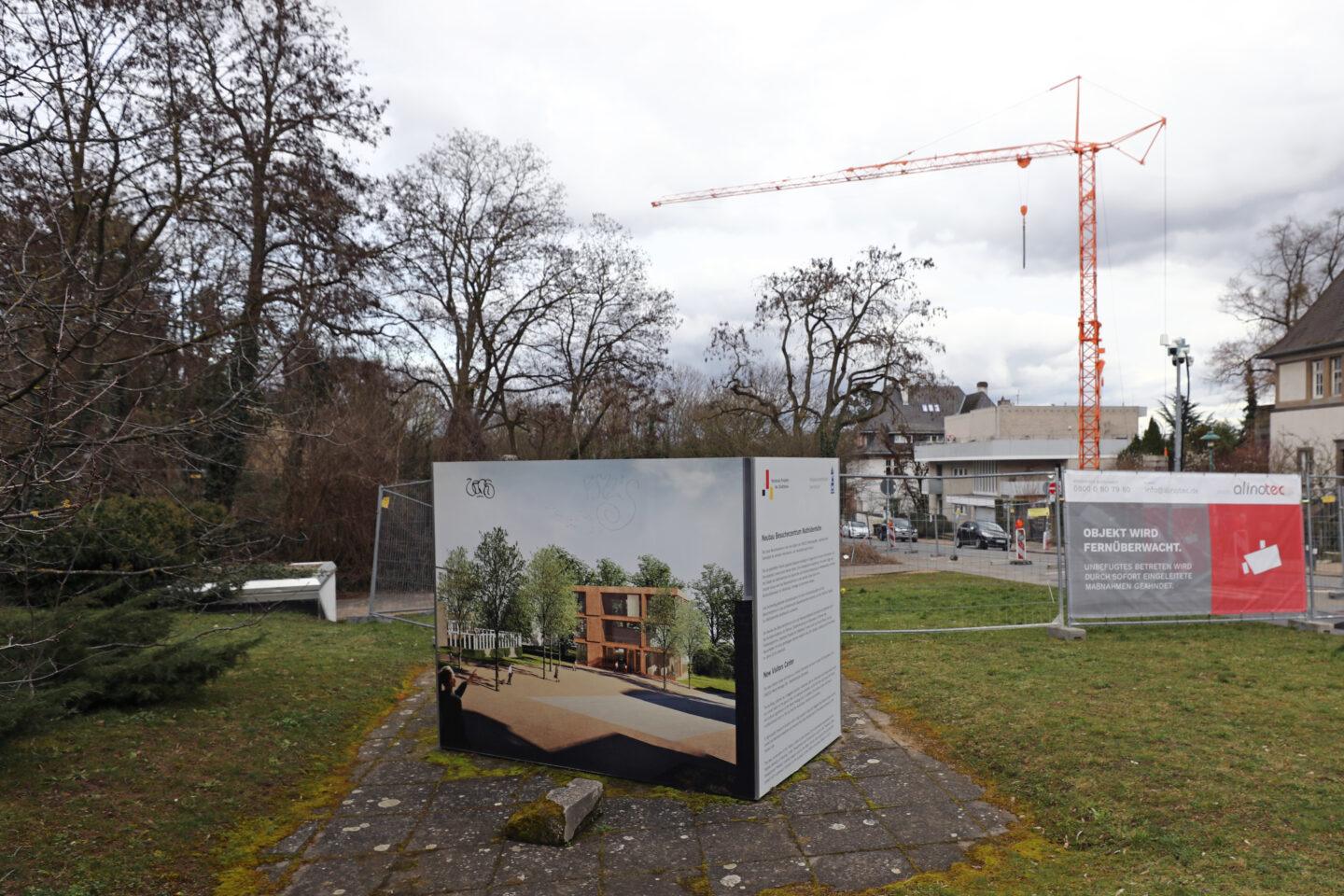
The city of Darmstadt, a center of science and research, has temporarily halted the planned construction of a new information center for the UNESCO World Heritage Site of Mathildenhöhe. A temporary moratorium has been imposed on the project. Instead of continuing with the current plans, the city will first address the fundamental question of how the World Heritage Site will be presented, organized, and financed in the future.
Mayor and Head of Cultural Affairs Hanno Benz and Head of Urban Planning Paul Georg Wandrey presented a corresponding proposal to the city council on Monday (August 17). Decisive factors for the decision, besides conceptual questions, are primarily the significantly increased costs and the city's difficult budget situation.
The current plans for the information center are therefore discontinued. However, the idea of an information center itself is not entirely off the table. Whether and in what form it will be realized later will be examined without prejudice.

Costs rose from 6.2 to around 21 million euros
The idea of a visitor center on the Mathildenhöhe dates back to 2016. Following a site analysis and a design competition, it was decided in 2019 to build a visitor and information center with approximately 1,500 square meters of usable space on the eastern slope. At that time, the costs were estimated at around 6.2 million euros.
With the inclusion of the Mathildenhöhe on the UNESCO World Heritage List in 2021, the circumstances changed. UNESCO and ICOMOS criticized the plans and issued binding guidelines regarding building areas, building height, and design. Extensive redesign and a reduction in the building's size became necessary.
The redesign, undertaken primarily in 2022 and 2023, did not lead to lower costs. Instead, the estimated construction costs rose to around 21 million euros.
Furthermore, according to the city, there is currently no independent mediation concept from which requirements for spaces, content, target groups, and functions have been systematically derived. Funding for the development and implementation of such a concept would not be allocated until the 2027 budget.
“In retrospect, it is also clear that it would have been more logical to prioritize the mediation concept over the construction planning from the outset,” explains Mayor Hanno Benz. “We are now consistently acting on this insight: We are correcting the order before further funds are committed.”
Significant renovation needs on the Mathildenhöhe
Alongside the planned new construction, there is a significant need for investment in the preservation of the existing buildings and structures of the World Heritage Site. The city currently estimates approximately €15.6 million for the renovation of the Upper Hessian House, the Ernst Ludwig House, the Wedding Tower, the Bacchus Fountain, and other structures.
As early as 2025, the administration had therefore commissioned a review of possible savings at the information center and asked the World Heritage Advisory Board to reassess the dimensions and costs of the design.
Given the city's budget situation, it is now reviewing the entire concept. It also points to information and visitor centers at other World Heritage sites: comparable facilities were built in Mainz for around five million euros and in Bamberg for around nine million euros.
According to Benz and Wandrey, an information center can be part of the communication of World Heritage, but it does not necessarily have to be its central or most important form.
New concept to be considered before new construction decision
Darmstadt will therefore first develop a specialist concept for the communication of the World Heritage Site. Existing facilities and services will also be taken into account. At the same time, the Mathildenhöhe will be more closely integrated with the neighboring UNESCO World Heritage sites of Messel Pit and Lorsch Abbey.
Various models for providing information to visitors will be examined – from a central building to decentralized services, digital solutions, or temporary options. Only on this basis will a new political decision be made regarding whether an information center will be built and, if so, what its size should be.
Greater consideration should also be given to the identification of Darmstadt's urban society with the World Heritage site and its tourist marketing.
“This break with tradition is not a abandonment of education or a departure from the World Heritage mission,” Benz and Wandrey emphasize. Rather, the aim is to place the education of World Heritage on a sustainable footing in light of changed circumstances and limited financial resources.
The city plans to start construction projects with a fixed budget in the future
Benz and Wandrey also intend to draw conclusions from the project's development for future urban construction projects. According to their vision, a binding budget ceiling should be set before any planning begins.
The financially viable framework should include all ancillary construction costs as well as a 15 percent risk buffer for unforeseen expenses. The planning must then be adapted to this budget – and not the other way around.
“The city’s future project planning must no longer be based on maximum demands and the highest standards – the ‘wish-fulfillment’ principle is finally over,” explain Benz and Wandrey.
According to the city, this is a reaction not only to the experiences with the World Heritage project, but also, more generally, to rising construction costs and limited financial leeway.
The eastern slope is also to be further developed
The moratorium does not mean that the eastern slope of the Mathildenhöhe will remain unchanged. The city also intends to develop a new concept for this area.
The aim is a more moderate development that integrates better into the topography, vegetation, and the overall protected historical area. Further development should combine the requirements of historic preservation, landscape conservation, economic viability, and organizational considerations.
According to the city, the long-term goal is an integrated "World Heritage system" for the Mathildenhöhe. This system will consider both the protection and promotion of the UNESCO World Heritage site, as well as its significance for Darmstadt and the entire region.
The next steps
- Develop a specialist concept for the communication of World Heritage sites
- Include existing services and infrastructure
- Consider collaboration with the Messel Pit and Lorsch Abbey
- Strengthening the identification of the Darmstadt population with the World Heritage Site
- Integrate tourism marketing into city-wide communication
- examine central, decentralized, digital and temporary information services
- Reconceptualizing the development of the eastern slope
- Only then will a decision be made about a possible new building
(DARMSTADT – RED/PSD/ho)
Featured image: Archive photo: Arthur Schönbein