

Experts explain the limited financial resources available to municipalities and the impact on the city budget
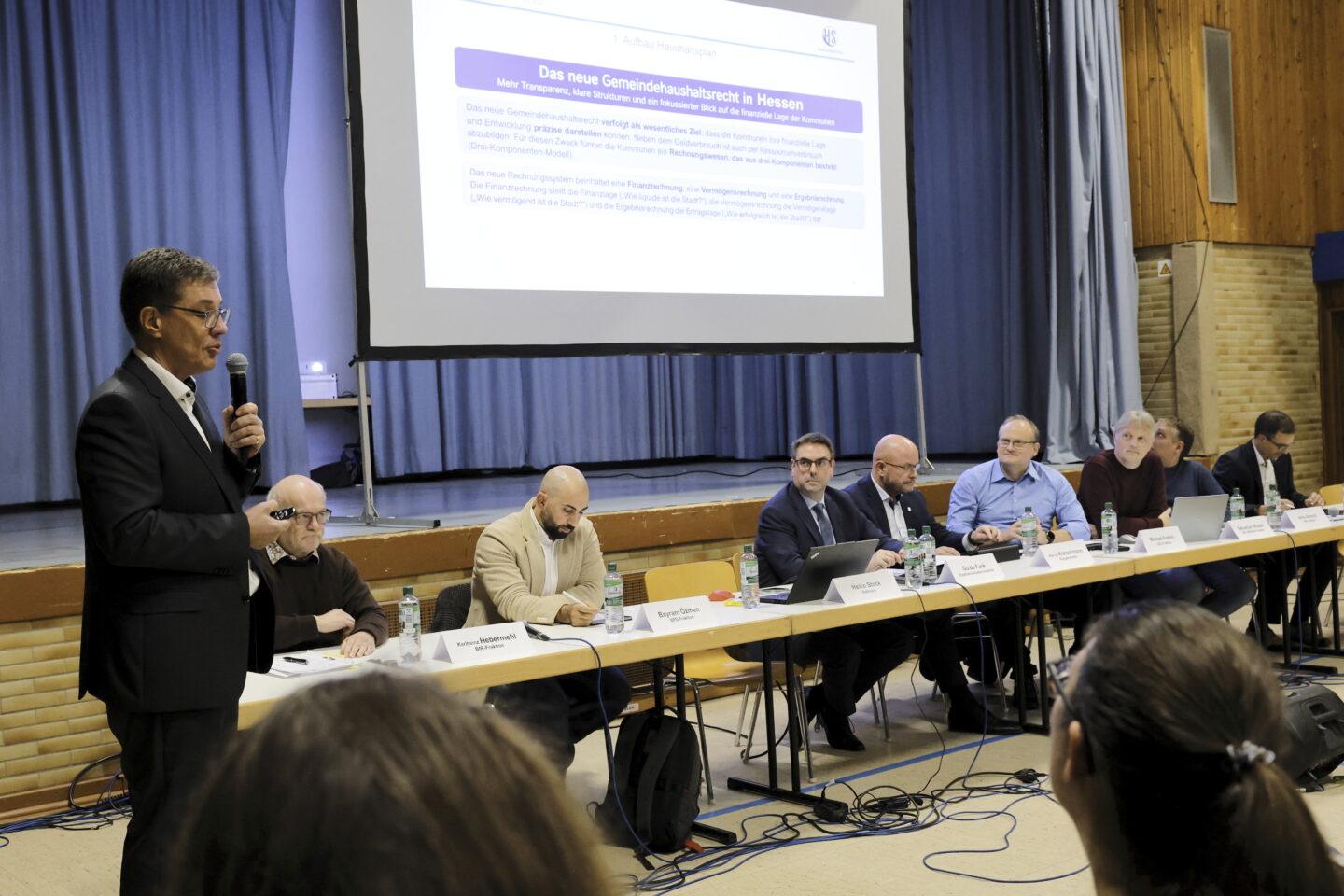
Municipal finances and budget law were the focus of the public meeting held in the Christoph-Bär-Halle in Riedstadt. City council chairman Guido Funk had invited two experts from Freiherr vom Stein Municipal Consulting, Carsten Ulrich and Heiko Stock, to speak. During the evening, it became clear how limited the financial leeway of cities and municipalities is and what influence legal requirements have on municipal budgets.
“You have chosen a very exciting topic,” Funk greeted the residents of Riedstadt at the town hall meeting.
In addition to moderator Carsten Ulrich and speaker Heiko Stock, Mayor Marcus Kretschmann and the representatives of the factions in the city council also took their places on the podium: Michael Fraikin (CDU), Bayram Özmen (SPD), Karlheinz Hebermehl (BfR), Sebastian Wispel (Greens) and Jens Amend (FW).
The Freiherr vom Stein Municipal Consulting firm was founded by the Hessian Association of Towns and Municipalities (HSGB) to meet the increased demand for consulting services from municipalities. As former mayors, both Ulrich and Stock possess many years of practical experience with the challenges of municipal budgets.
Limited room for maneuver for cities and municipalities
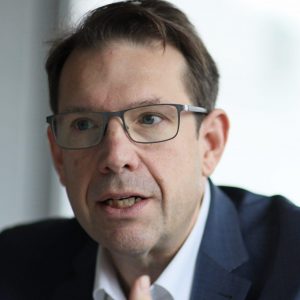
In his detailed presentation, Heiko Stock explained how little influence municipalities have on numerous revenues and expenditures.
Cities and municipalities must fulfill their legally mandated duties, the scope and costs of which are largely determined by the federal and state governments. At the same time, there is a structural imbalance between the delegated tasks, the available revenue, and the actual liquidity of their resources.
According to the speaker, a total of 79 percent of Hessian municipalities had a deficit in the 2025 fiscal year.
Against this background, Riedstadt's financial situation should also be considered.
“You will see what a Herculean effort it was to submit a balanced budget proposal for 2027,” Stock explained.
Property tax as one of the few levers to pull
On the revenue side, municipalities have only limited options to influence their own financial situation.
For example, they cannot influence the amount of key allocations from the state. There is also little room for maneuver regarding fees. Many fees, such as those for issuing an identity card, are set by the federal government.
One of the few avenues for influence lies in municipal taxes. However, revenues from business taxes depend heavily on the economic performance of companies and are therefore difficult to predict. Moreover, according to Stock, only about 30 percent of business tax revenues remain with the municipality.
This puts the focus particularly on property tax B for developed and undeveloped land.
In Riedstadt, the city councilors decided to increase the property tax rate (Grundsteuer B) to 1,600 points, effective January 1, 2026.
“They were a bit ahead of the curve in Riedstadt,” Stock said, referring to this decision. Meanwhile, numerous other Hessian municipalities are facing property tax increases, as many cities and towns are confronted with liquidity problems.
County and school levies burden the city budget
Many expenditure items are also fixed. In Riedstadt, the largest items are the district and school levies.
Since the districts have only limited sources of revenue of their own, their funding gaps are passed on to the towns and municipalities belonging to the district via levies, according to the speaker.
For Riedstadt, this means that around 40 percent of the revenue had to be paid back to the district this year.
Stock illustrated the impact of even minor changes to the district levy with a concrete calculation: An increase in the district levy of just one percentage point results in a calculated additional burden of around 414,000 euros for Riedstadt.
According to his calculations, this corresponds to 54 additional tax rate points for property tax B.
Difference between renovation and investment
Using the example of a daycare center, Stock also explained the different effects of renovation measures and investments on the municipal budget.
For example, if a leaky roof is repaired, the corresponding expenses are included in the operating budget of the respective year.
If, on the other hand, the daycare center is expanded by means of an extension, this is an investment that is initially reflected in the financial budget.
"A property tax increase is generally not a direct consequence of an investment," Stock emphasized.
Citizens discuss property tax and district levy
In the subsequent question and answer session, the visitors had the opportunity to address their questions to the experts, the mayor and the representatives of the city council factions.
Municipal finances were also the main focus of the discussion. Topics included the district levy and property tax C, which allows for the separate taxation of building-ready but undeveloped land.
(RIEDSTADT – RED/PSR)
Featured image: Heiko Stark gave a presentation on municipal finances. Seated on the podium (from left): Karlheinz Hebermehl (BfR), Bayram Özmen (SPD), City Council Chairman Guido Funk, Mayor Marcus Kretschmann, Michael Fraikin (CDU), Sebastian Wispel (Greens), Jens Amend (FW), and Carsten Ulrich. Photo: City of Riedstadt