
At the memorial service in the historic town hall, speakers and students commemorate the victims of war and persecution – appeals for democracy, tolerance and humanity
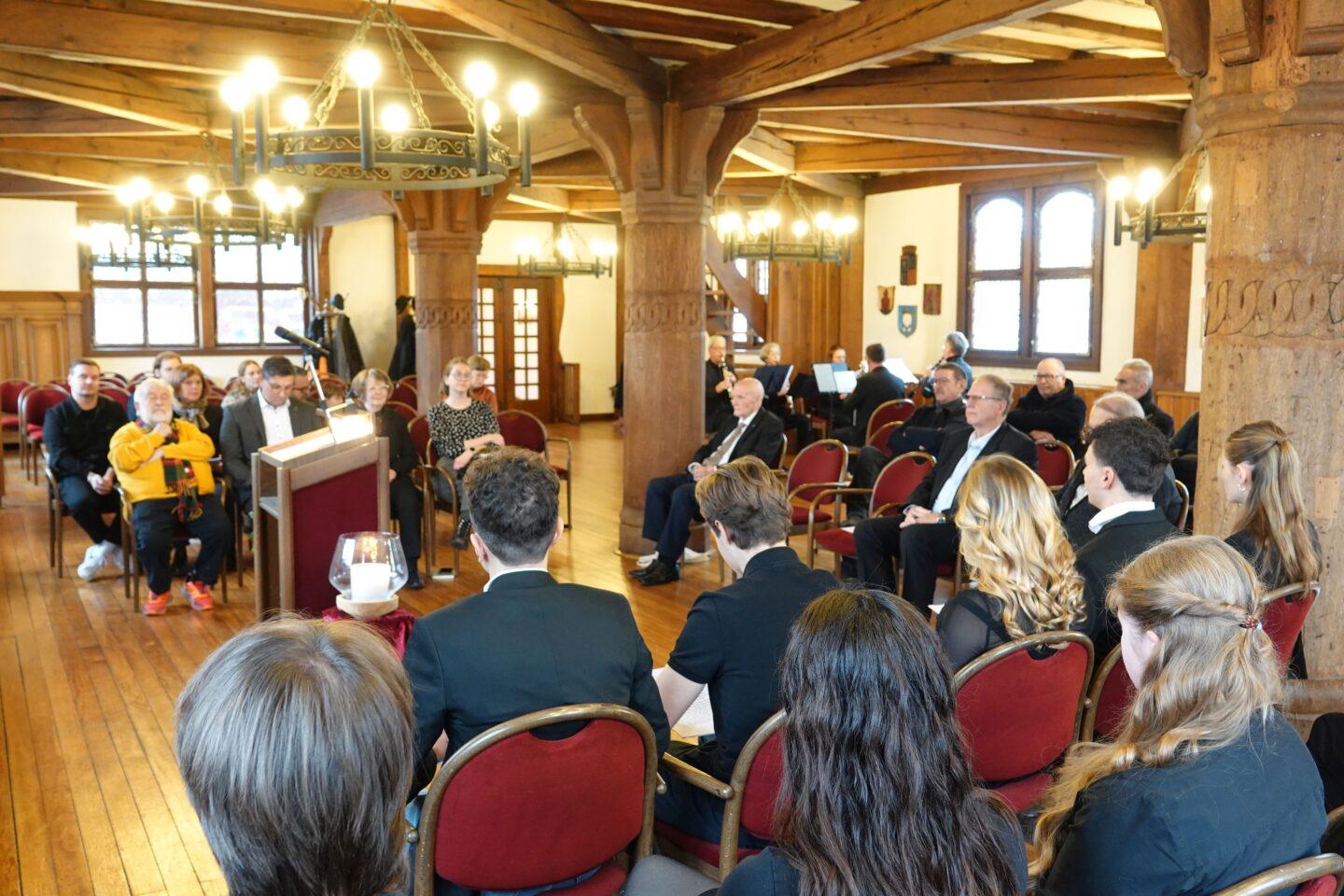
The National Day of Mourning is a day of remembrance, but also a warning for the present. At a memorial service in the historic town hall in Groß-Gerau on Sunday, November 15, 2026, around 40 participants commemorated the victims of the two World Wars, Nazi persecution, and the armed conflicts of our time. The speeches made it clear that peace, democracy, and social cohesion are not to be taken for granted. The reflections of students from the Prälat-Diehl-School, who grappled with war, disenfranchisement, and the importance of remembrance, were particularly poignant.
Remembering the victims of war and persecution
The memorial service focused on the commemoration of the dead by the German War Graves Commission. It remembered not only the millions of dead from the two World Wars, but also people who were persecuted and murdered during the Nazi regime for racist reasons, because of their sexual identity, or because of illness.
At the same time, attention was focused on the victims of current wars and armed conflicts worldwide.

“We mourn with all those who grieve for the dead and share their pain,” reads the memorial message of the German War Graves Commission.
Groß-Gerau's mayor, Jörg Rüddenklau, reminded everyone that approximately 17 million people lost their lives in the First World War and an estimated 50 million in the Second World War.
Behind each of these numbers is an individual person with hopes, dreams and their own life story.
Mayor warns of societal division
With regard to the current wars, Rüddenklau emphasized that remembrance should not become a mere obligation.
The crimes of the past and the suffering of the present should serve as a lasting reminder to resolutely oppose all forms of misanthropy, anti-Semitism, racism and violence.
Peace requires respect, tolerance, and a willingness to meet each other halfway.
The mayor expressed concern about developments within society. Social cohesion is crumbling, democratic processes are increasingly being questioned, and scapegoats are being sought more and more frequently for societal problems.
The National Day of Mourning therefore obliges all people to work towards peaceful coexistence and to protect democracy.
VdK calls for strengthening of international law
Wolfgang Weber, chairman of the VdK local association Groß-Gerau, focused on the worldwide armed conflicts.
In his speech, he referred to 209 violent conflicts and 117 million people who are refugees worldwide.
Weber also addressed the consequences of the Russian war of aggression against Ukraine. According to him, around two million soldiers on both sides have been killed since the start of the invasion. This figure does not include civilian casualties.
He was particularly critical of the increasing attacks on civilian infrastructure. Power supplies, communication networks, and transport routes were being deliberately targeted, often with drones.
The civilian population suffers most as a result. The boundaries between military objectives and civilian infrastructure are becoming increasingly blurred in modern warfare.
War should not be a tool of politics, but rather reveals its failure, Weber emphasized.
“We must strengthen international law so that the law of the strongest does not prevail,” was his central demand.
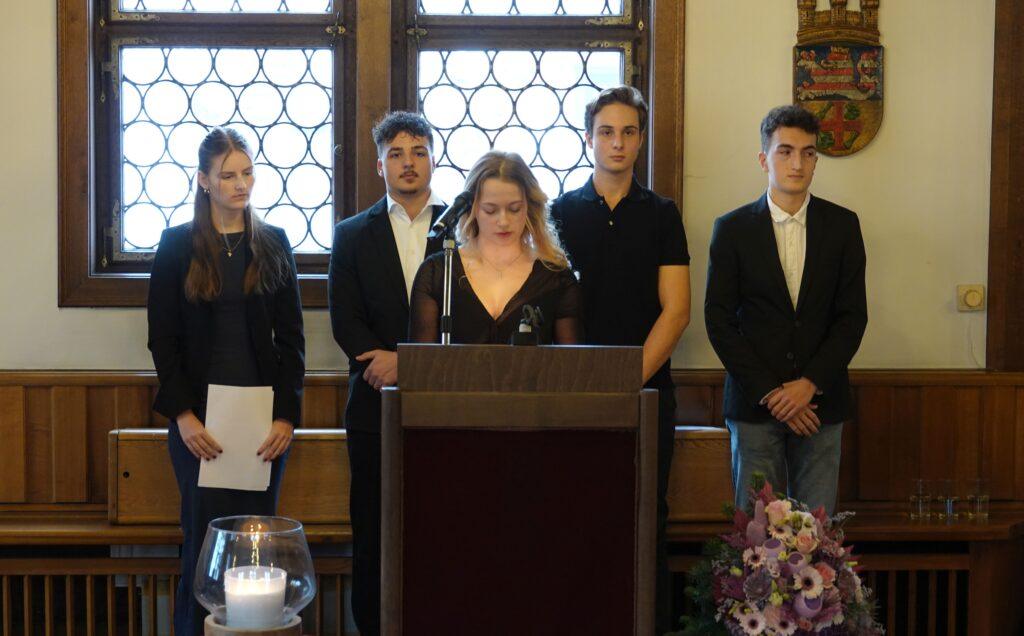
Students remember "Never again"
Five students from the upper grades of the Groß-Gerau Prälat-Diehl-Schule added a special touch.
Emilia Nowak, Helena Kullmann, Moritz Hartl, Luca Justus and Jannis Rupprecht shared their personal thoughts on the National Day of Mourning.
They discussed the importance of democracy, the disenfranchisement of people during National Socialism, and the Russian war of aggression against Ukraine.
They made it clear how difficult it is for young people to imagine what it means to grow up in a war and to be robbed of their own childhood and youth.
War knows no winners, but leaves wounds that often persist for decades.
That makes it all the more important to constantly remind ourselves of the value of peaceful coexistence.
The lesson of "Never again" must not be forgotten, but must remain a binding guiding principle for future generations.
Peace means more than the absence of violence
In her contribution, Pastor Josephine Haas from the Groß-Gerau city church community addressed the question of what actually constitutes peace.
She drew on ideas from the writer Joana Osman's book "Peace: A Real Utopia".
Positive peace means far more than the mere absence of violence. It also includes freedom, justice, and security.
A comprehensive peace for all peoples may seem like a utopia. Nevertheless, it is necessary to talk about peace and to oppose social division.
Prejudices must be questioned, contempt for humanity must be decisively rejected, and the normalization of violence must be prevented.
It is equally important to counteract the gradual erosion of democratic structures.
Gaps in Jewish history
Walter Ullrich, chairman of the association for the promotion of Jewish history and culture in the district of Groß-Gerau, spoke about the importance of personal grief and active remembrance.
During guided tours of the Jewish cemetery, he repeatedly witnesses how descendants of former Jewish residents of Groß-Gerau are overwhelmed by their emotions.
“I enter into grief through tears. Grief makes one profoundly human,” Ullrich explained.
At the same time, he drew attention to gaps in the local culture of remembrance.
Stolpersteine (memorial stones) have still not been laid for all Jewish people who were expelled from Groß-Gerau.
Therefore, commemorating the victims of Nazi persecution remains a task that is not yet complete, even locally.
Wreath-laying ceremonies at the town hall and in the city districts
The memorial service featured musical performances by the Riedstadt Music Workshop under the direction of Wolfgang Seidemann.
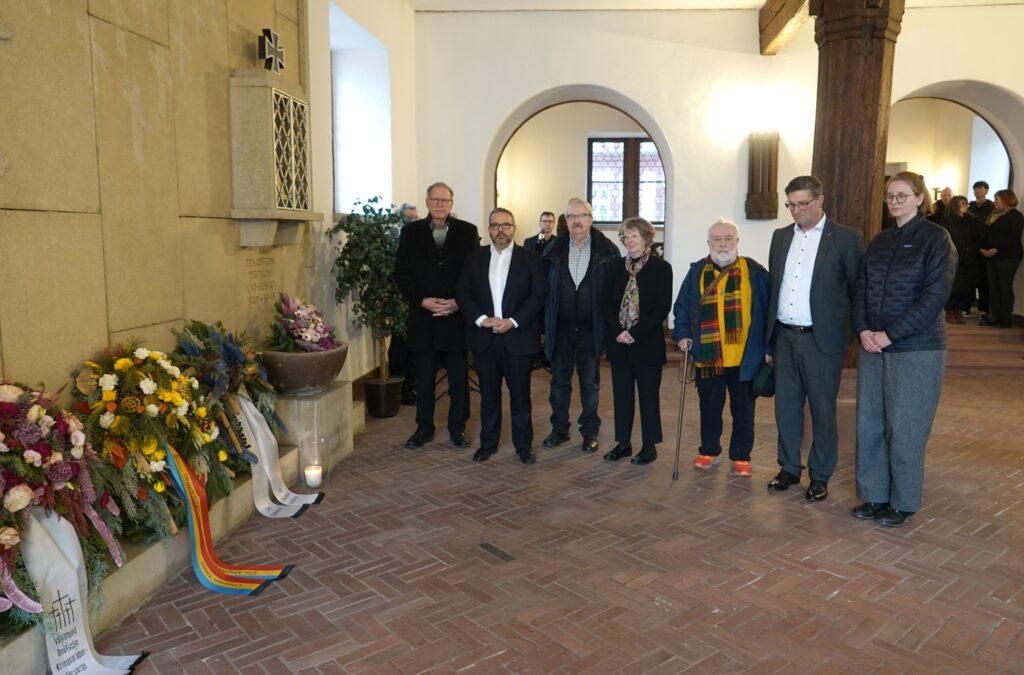
At the conclusion of the central event, representatives of the city, the VdK, the church and the association for the promotion of Jewish history and culture laid wreaths at the memorial on the ground floor of the historic town hall.
Those participating in the wreath-laying ceremony included Deputy City Council Chairman Sascha Reza, Mayor Jörg Rüddenklau, First City Councillor Susanne Theisen-Canibol, Wolfgang Weber and Matthias Keil from the VdK, Pastor Josephine Haas and Walter Ullrich.
Further wreath-laying ceremonies took place in the cemeteries in Wallerstädten, Berkach and Dornheim.
The memorial service made it clear that the National Day of Mourning is not solely about remembering past suffering. It is also a call to take responsibility for the present and to stand up for peace, democracy, and humanity.
(GROSS-GERAU – RED/PSGG)
Featured image: The audience at the commemoration ceremony for the National Day of Mourning on November 15, 2026, in the historic town hall of Groß-Gerau. Photo: Groß-Gerau district town/Jörg Monzheimer