

A four-meter-high noise barrier simultaneously creates new living space – the federal government covers 90 percent of the costs
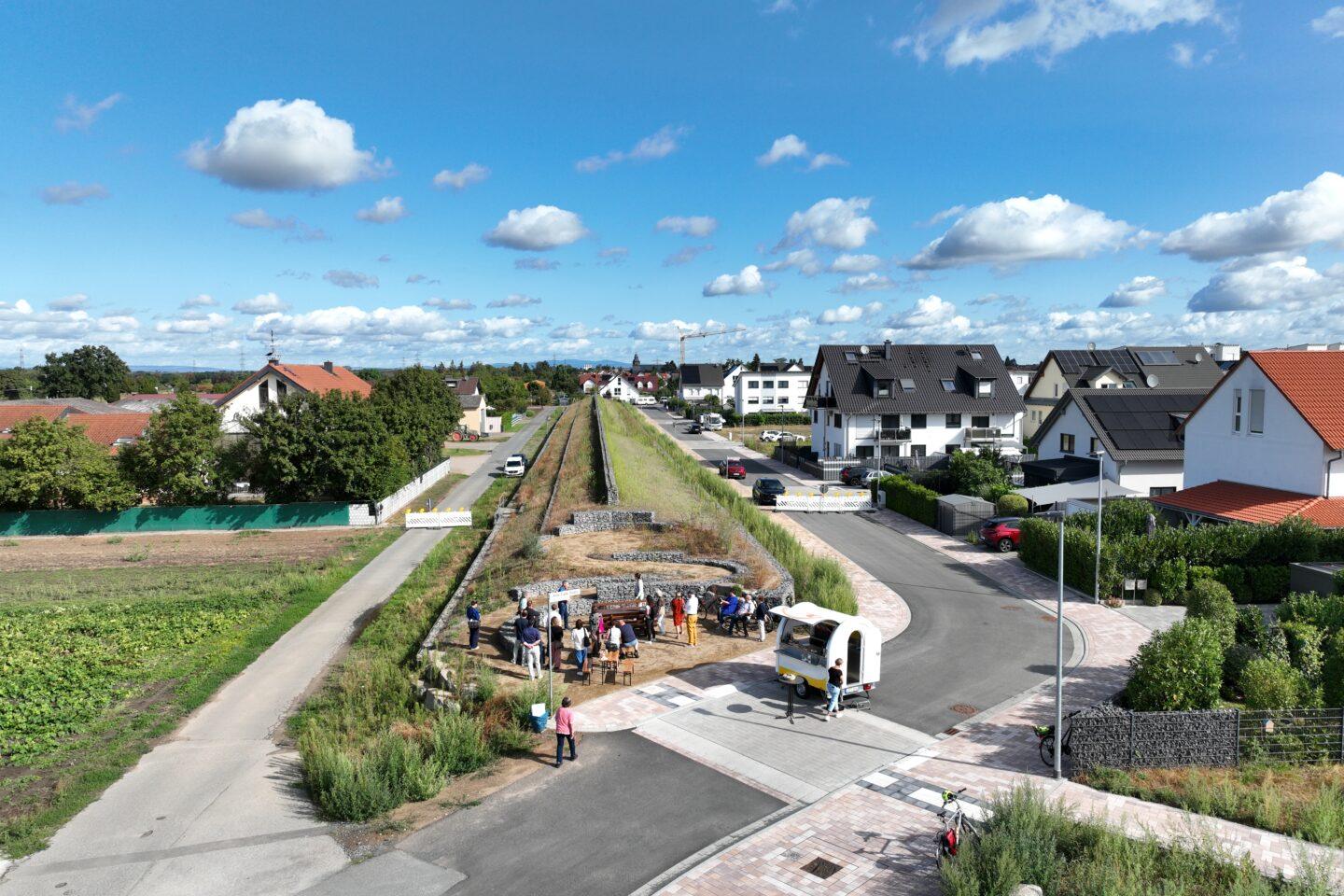
The natural dune in Griesheim has been officially inaugurated. Mayor Geza Krebs-Wetzl presented the greened noise barrier in the southwest residential area on Thursday, August 20. The four-meter-high structure separates the residential area from the adjacent farms and is also intended to provide habitat for numerous animal and plant species.
"The noise barrier in the form of a natural dune has created a special added value for nature in western Griesheim," said Krebs-Wetzl. In addition to the required noise protection, it also creates "a habitat for many different species.".
The natural dune in Griesheim is 240 meters long
The dune is four meters high, 14 meters wide, and 240 meters long including its ends. Approximately 6,000 cubic meters of sandy soil and 1,000 linear meters of gabions were used in its construction. The area was planted with a dry sandy grassland mixture of around 100 species, as well as wild roses and sea buckthorn. According to the city, the mixture used also occurs naturally in the Griesheim dunes, is insect-friendly, and requires little maintenance.

The costs are expected to be around €850,000. Ninety percent will be financed through the federal funding program "Adapting Urban and Rural Areas to Climate Change" of the Federal Ministry for Housing, Urban Development and Construction (BMWSB), with the city of Griesheim contributing ten percent. The original cost estimate was around €1.39 million.
The actual construction period lasted just under six months: from April 14th to October 24th, 2025. The project duration extends from the funding commitment on November 18th, 2020 to the end of the approval period on December 31st, 2026.
Noise protection between residential area and farms
The noise barrier is a requirement of the development plan for the southwest residential area. The distance between the farms and the residential buildings is only about 30 meters. According to a noise impact assessment, without the barrier, a minimum distance of 120 meters would be necessary to maintain a noise level of 40 decibels (A) at night.
“The natural dune combines three functions: noise protection, public green space, and a natural habitat,” said project manager Matthias Dorweiler. The federal funding also provides financial relief for local residents. Without the funding, they would have had to bear a significant portion of the development costs for the required noise protection measures, according to the city.
The model for the facility is the FFH nature reserve "Griesheimer Düne". This aims to combine the necessary noise protection with a publicly accessible green space and a comparatively low barrier effect.
Tree-lined avenue on Anne-Frank-Straße will follow in autumn
Although the natural dune in Griesheim is complete, the surrounding work is not yet entirely finished. This autumn, a tree-lined avenue will be planted along Anne-Frank-Straße to provide visual screening. The plan includes 28 trees, among them field maple, French maple, whitebeam, and mulberry.
The trees are being subsidized with 80 percent funding through the federal funding program “NKK – Natural Climate Protection in Municipalities”.
Further information
Information about the Griesheim natural dune and the funding project:
www.griesheim.de/wohnen-umwelt/
(RED/PM/Verena Brückmann)
Featured image: City of Griesheim