

In the event series "Word Exchange", experts, young people and politicians discuss the protection of nature and habitats
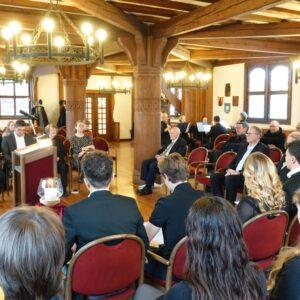
How can the Groß-Gerau district prepare for the consequences of climate change? What measures are necessary to preserve nature, habitats, and the quality of life for its residents in the long term? These questions were the focus of an event organized by the Climate Protection Department at the Groß-Gerau District Office. As part of the "Word Exchange" series, the district's climate adaptation concept, adopted in June 2026, was presented and discussed with representatives from various sectors of society.
The focus was particularly on the increasing impacts of drought, aridity, heavy rainfall, and flooding on the region. The concept outlines which changes are already noticeable and what measures the district and its municipalities can take to respond to future challenges.
From the frozen Rhine to dry summers
District Administrator Thomas Will illustrated the changes in the regional climate using personal memories from his family.

His grandmother had told him about a winter when the Rhine had frozen over so completely that there was even a carousel on the ice.
Will contrasted this with today's summers, in which the river sometimes only flows as a trickle.
For the district administrator, this contrast is a striking example of how clearly the consequences of climate change are now noticeable in the region.
Increasingly extreme weather events present cities and municipalities with a variety of challenges. While prolonged periods of drought put a strain on soils, forests, and green spaces, heavy rainfall and flooding can cause significant damage.
The climate adaptation concept is intended to help identify such risks early and develop appropriate countermeasures.
Climate adaptation as a shared task
A key focus of the event was the exchange of different perspectives.
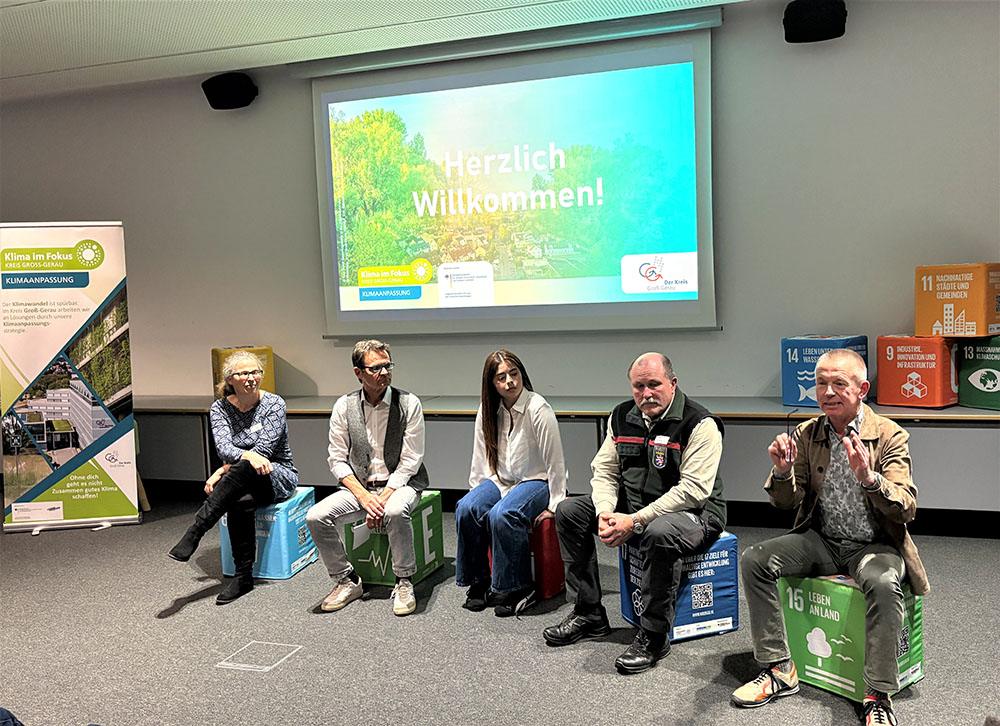
In a moderated dialogue, representatives from nature conservation and forestry, together with a district student representative and District Administrator Thomas Will, discussed their experiences, challenges and possible courses of action.
It became clear that climate adaptation cannot be the sole responsibility of individual authorities or departments.
Rather, it requires close cooperation between administration, politicians, experts, and the public. Diverse knowledge and experience should help to develop suitable measures for the respective local conditions.
The concept adopted in June provides a basis for this and is intended to support the Groß-Gerau district in its long-term preparation for the consequences of climate change.
Nature conservation and biodiversity are the focus
The event was also dedicated to the sustainability goal "Life on Land". This goal is one of the 17 sustainability goals of the United Nations and is known as Sustainable Development Goal 15, or SDG 15 for short.
The focus is on the protection of terrestrial ecosystems, the sustainable use of natural resources and the preservation of biodiversity.
The discussion at the district office made it clear how closely these topics are linked to adaptation to climate change.
Healthy forests, resilient ecosystems and the responsible use of natural resources play an important role in preserving habitats in the Groß-Gerau district, even under changing climatic conditions.
Poetry slam accompanies the evening
The event was given an artistic framework by the poetry slammer Sebastian Hauf.
He opened and closed the evening with his texts, addressing the topics of climate change, responsibility and change.
“Adapting doesn’t mean giving up. Adapting means developing,” was one of his central messages.
The literary contribution complemented the professional discussions with a personal and emotional perspective on the challenges of climate change.
Federal funding for climate adaptation
The development of the climate adaptation concept is being supported within the framework of the German Adaptation Strategy to Climate Change (DAS).
The funding is provided by the Federal Ministry for the Environment, Climate Protection, Nature Conservation and Nuclear Safety based on a resolution of the German Bundestag.
With this concept, the Groß-Gerau district aims to create the basis for systematically considering climate risks and making the region more resilient to the consequences of climate change in the long term.
(DISTRICT OF GROSS-GERAU – RED/PSKGG)
Featured image: Participants in the discussion about the climate adaptation concept (from left): Sandra Wolf (Landscape Conservation Association), moderator Christian Döring, Ella Yurdakul (District Student Representative), Klaus Velbecker (HessenForst) and District Administrator Thomas Will. Photo: District Administration