

International research team measures the strength of a chemical bond with seaborgium for the first time – results published in “Nature”
An international research team led by scientists from the GSI Helmholtz Centre for Heavy Ion Research and FAIR in Darmstadt has achieved a remarkable measurement: For the first time, the strength of a chemical bond in a compound with a superheavy element has been experimentally determined. The results provide new insights into how the chemical properties of elements change under extreme conditions.
The focus of the investigation was the artificially produced element seaborgium (Sg) with atomic number 106. The scientists examined a compound consisting of one seaborgium atom and six carbon monoxide groups, the so-called hexacarbonyl complex Sg(CO)₆.
The surprising result: The chemical bond is weaker than would have been expected based on the element's position in the periodic table. This is due to effects that can be explained by Einstein's theory of relativity. The research findings were published in the renowned scientific journal "Nature".

When Einstein's theory of relativity influences chemistry
Superheavy elements with atomic numbers between 104 and 118 do not occur naturally in sufficient quantities for such investigations. They must be artificially produced in nuclear fusion reactions at particle accelerators.
This is a complex process: often only a few atoms are produced per day. Furthermore, the resulting atomic nuclei are extremely unstable and decay radioactively within a very short time.
In seaborgium, the high positive charge of the atomic nucleus strongly influences the motion of the electrons. Electrons near the nucleus reach speeds at which relativistic effects play a significant role.
This changes the electron structure of the atom. This, in turn, affects how the element forms chemical bonds with other atoms or molecules.
Seaborgium is behaving differently than expected
In the periodic table, seaborgium belongs to the same group of elements as chromium, molybdenum, and tungsten. Within this group, the strength of the chemical bond studied increases from chromium through molybdenum to tungsten.
Following this pattern, one would have expected the corresponding bond to be particularly strong in the even heavier Seaborgium.
However, the measurements showed the opposite.
“From chromium to molybdenum to tungsten, the bond strength increases, so it should actually be strongest in seaborgium. However, the measurement shows that the high atomic number of seaborgium changes its electronic structure, which reverses the trend and leads to a weaker bond,” explains Dr. Alexander Yakushev of GSI/FAIR, spokesperson for the international research collaboration.
Quantum chemical calculations that take relativistic effects into account can explain this observation. Simpler models without these effects, on the other hand, would have predicted a further increase in bond strength.
Only 75 seaborgium atoms were needed for the study
The experimental investigation presented the researchers with particular challenges, as the produced seaborgium atoms only exist for fractions of a second.
The isotope Seaborgium-259 was produced at GSI/FAIR in Darmstadt. The nuclear states studied have lifetimes of less than half a second.
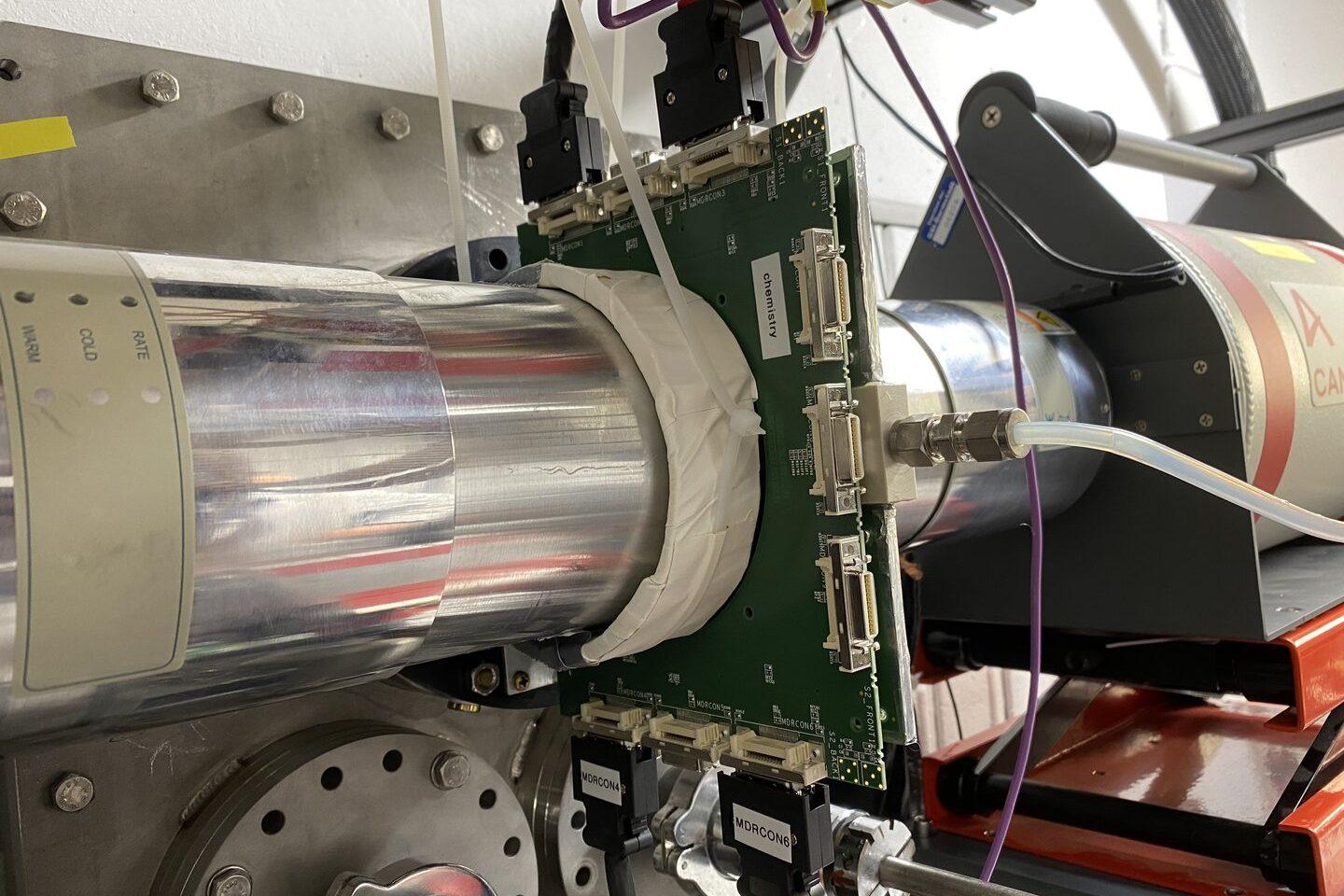
Using the TASCA experimental setup, the transactinide separator and chemical apparatus, the generated atoms were isolated and then introduced into a carbon monoxide-containing gas atmosphere.
The chemical compounds under investigation were able to form there. Two detectors arranged one behind the other served to register the radioactive decays of the individual atoms and to distinguish between different reaction products.
In total, the researchers detected 75 seaborgium atoms. Only three of these were registered in the detector for the hexacarbonyl compound.
For comparison, the team also examined short-lived tungsten isotopes. In these, 17 percent of the atoms formed the corresponding compound.
From this difference, the scientists were able to deduce that the bond studied is about four kilojoules per mole weaker in seaborgium than in tungsten.
Years of research lead to success
The compound Sg(CO)₆ was first synthesized around ten years ago at the RIKEN Nishina Center in Japan. Scientists from Johannes Gutenberg University Mainz and GSI/FAIR were among those involved in the experiment at that time.
Even then, the compound was considered promising for investigating chemical bond strengths. However, initial attempts to actually determine these strengths were unsuccessful.
Only the combination of rapid chemical synthesis methods, high yields and sensitive detection methods for radioactive decays has now made successful measurement possible.
International cooperation as a basis
Professor Christoph E. Düllmann, head of the departments for the chemistry of superheavy elements at GSI/FAIR and at the Helmholtz Institute Mainz, as well as professor at the Johannes Gutenberg University Mainz, emphasizes the importance of international cooperation.
“This groundbreaking experiment would not have been possible without interdisciplinary and international collaboration between research institutions around the world,” explains Düllmann.
The study complements the research programs of GSI and FAIR, which deal, among other things, with the origin of the elements in the universe and their basic properties.
Following the successful experiment, the scientists are already preparing further investigations. In the future, they also plan to explore chemical compounds with elements even heavier than seaborgium.
(DARMSTADT – RED/GSI)
Featured image: Experimental setup behind the TASCA separator: the first detector behind the reaction chamber, surrounded by two germanium detectors. Photo: GSI