
Midterm interview with Darmstadt's mayor
By Uli Diehl
Darmstadt's mayor takes stock at the halfway point of his term – on political resistance, new majorities, security, mobility and the challenges of a highly indebted municipality.
Three years have passed since Hanno Benz unexpectedly won the election for mayor of Darmstadt. Since then, the political landscape of this city of science has changed significantly. The once dominant Green-led coalition has given way to a new political constellation, while the city simultaneously faces major challenges: strained finances, a housing shortage, mobility conflicts, the debate surrounding the drug scene in the city center, and the question of how Darmstadt can remain economically viable in the future. At the halfway point of his term, Benz takes stock. He discusses political opposition, his successes, unresolved problems, and why he is convinced that pragmatism is often more important than ideology.
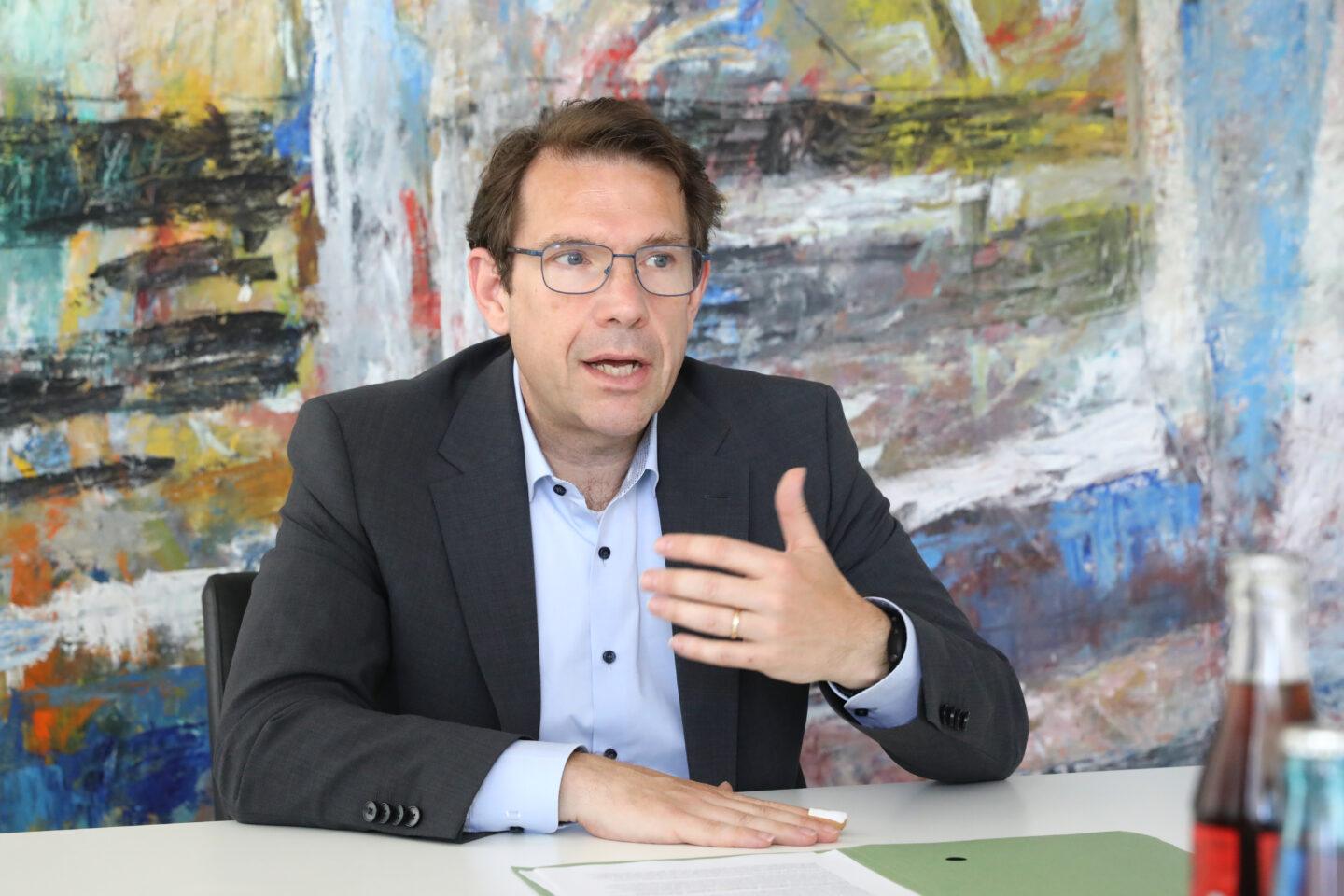
Mr. Benz, you have been in office for three years. How difficult was it to avoid political gridlock and set your own priorities without a parliamentary majority?
Of course, this was not an easy starting point. Anyone governing without a firm majority in the city council first has to overcome a great deal of resistance. For some, the result came as a surprise at the time, and some political figures had to get used to the fact that suddenly there was a mayor in office who was not part of their coalition at the time.
Nevertheless, through hard work, perseverance, and numerous discussions, we have succeeded in breaking down existing structures and initiating change. My impression is that, in the end, the better arguments often prevail. We have been able to set important priorities, particularly in economic and industrial policy. We have modernized and realigned economic development, further developed the city's economy, organized the change of management at ENTEGA, successfully overseen the merger of the savings banks, and laid important groundwork for the future of the hospital.
Interestingly, the political process often followed the same pattern: A proposal was initially viewed critically or even rejected. We then continued working on it, discussing it, and searching for solutions. In the end, many of these projects were approved across party lines. This shows that constructive cooperation is possible when the well-being of the city is the priority.
Talks about a so-called Kenya coalition of the Greens, SPD, and CDU ended in the spring. Do you still see any chance for a rapprochement?
First, it must be noted that the SPD and CDU offered the Greens the opportunity to enter into coalition negotiations. Instead, the talks were publicly declared over.
A stable partnership now exists between the SPD, CDU, UFFBASSE, and FDP. This alliance is united above all by the desire to pragmatically develop the city and find concrete solutions to Darmstadt's challenges. We share the wish to take responsibility for the city and move it forward.
At the same time, we are open to collaborating with all democratic factions on substantive issues. Ultimately, it shouldn't be about who makes a proposal, but whether it's good for Darmstadt. The voters made it clear in both the mayoral and local elections that they want change. We take this signal seriously.
You were recently elected Federal Vice President of the Social Democratic Association for Local Politics. What does that mean for Darmstadt?
Many decisions made at the federal or state level have a direct impact on cities and municipalities. Therefore, it is important that local politicians can contribute their experience and represent the interests of their communities.
For Darmstadt, this means we have an additional voice in Berlin. Issues such as municipal financing, investments in infrastructure, housing construction, and the energy transition are often decided at higher political levels. If municipalities are heard there early on, the local citizens ultimately benefit as well.
The Social Democratic Association for Local Politics brings together the experience of many local elected officials. This exchange helps to transfer successful concepts and to fight together for better framework conditions.
The SPD has consistently performed significantly better in Darmstadt than in many other major cities for years. What is the party doing differently here?
I believe that we as social democrats are very closely connected to the people and the neighborhoods. We know the needs of the citizens and what issues truly concern them.
In doing so, we try not to imbue politics with ideology, but rather to approach problems pragmatically. People rightly expect concrete challenges to be solved – be it in mobility, sports, culture, or social issues.
For me, social democratic politics means above all giving a voice to those who are often not heard. If that is the basis of political action, one remains close to the people and doesn't lose touch with everyday life.
Their new slogan is "There for everyone". Have you already been able to translate this claim into concrete policies?
I am convinced of this. “There for Everyone” means to me keeping all people in this city in mind – regardless of which district they live in or what interests they represent.
Both the mayoral election and the recent local elections have shown that not all citizens feel adequately represented anymore. Therefore, it was important to me to strengthen the connection between the town hall and the public.
For example, we retained the district offices in Arheilgen, Wixhausen, and Eberstadt, even though there had been considerations to close them. A registration office was also established in Arheilgen. With the new town hall foyer, we have created, for the first time since the Second World War, open and easily accessible entry to the town hall. Citizens can now directly address their concerns and receive support there.
In addition, there are formats such as "Mayor on Location," public consultation hours, and digital discussion opportunities via social media. It was and is important to me as mayor to be approachable and not just to look at problems from behind a desk.
A good example is the discussion about the tram connection to Wixhausen. Through a direct survey of residents, we were able to get a stalled issue moving again. Not every wish can be fulfilled, but people need to feel heard. That's the core of "DA for All".
The drug scene in Darmstadt's city center has been a problem for years. How can the debate be depoliticized and the problem solved?
First of all, we must acknowledge that many citizens find the situation stressful. I take the resulting worries and fears very seriously. I myself am also not satisfied with the current situation.
At the same time, I don't believe this complex problem can be solved with loud slogans or simple answers. It requires a long-term perspective and a balanced approach that considers both security aspects and social support services.
That's why we launched the ten-point plan "Safe City Center." This plan has resulted in measures such as the weapons-free zone and additional security improvements. At the same time, we are investing in prevention, for example through the Youth Justice Center and other social services.
Furthermore, we are increasing the presence of city and state police to create more security and visibility in public spaces. The problem won't disappear overnight. But we are working continuously to improve the situation step by step, keeping both the interests of residents and the social challenges in mind.
They wanted to de-ideologize the mobility debate and defuse the conflict between car and bicycle traffic. Have they succeeded?
At least among those willing to discuss the issue rationally and with a focus on solutions, this has been achieved. That was precisely the goal. With the reorganization of responsibilities in the transport sector, we have chosen a more pragmatic approach. Mobility policy must not be driven by ideologies, but rather must be oriented towards the actual needs of the people.
Of course, it's impossible to completely reconcile all interests. But we've shown that compromises are possible. One example of this is the resolution of the conflicts surrounding Dieburger Straße, which was a major point of contention during the mayoral election campaign.
It is also important that we do not only consider traffic within the city limits. Many challenges arise in conjunction with the surrounding district. Therefore, we are working together on a traffic development plan. Sustainable solutions can only be conceived regionally.
Darmstadt is among the cities with the highest per capita debt in Germany. Is the situation really that dramatic?
In my view, this indicator presents a distorted picture. The calculation includes not only the city's debt but also the liabilities of municipal companies.
ENTEGA, in particular, is investing heavily in the energy transition and the expansion of renewable energies. Such investments inevitably lead to higher liabilities. At the same time, however, they also create significant assets and future prospects. This aspect of the balance sheet is often overlooked in the public perception.
Of course, the overall financial situation of municipalities is difficult. This doesn't just affect Darmstadt, but cities and towns throughout Germany. Many tasks are being delegated by the federal and state governments without adequate funding. Therefore, we urgently need a fundamental reform of municipal finances. Without better financial resources for cities, the situation will hardly improve in the long term.
They have called for a rethink regarding so-called maximum standards. Will Darmstadt residents have to expect restrictions in the future?
No, that's explicitly not the point. We will, of course, continue to comply with all legal requirements. The question is rather whether, in times of tight budgets, we need to create additional standards everywhere that go beyond what is legally required.
Especially in the construction sector, we need to examine more closely in the future how economically projects can be implemented. This applies, for example, to schools, sports halls, or administrative buildings. Not every building needs to be individually planned if standardized solutions serve the same purpose.
We should also question whether urban planning regulations or specific equipment standards are truly necessary or simply create additional costs. The goal is not to reduce services, but to use existing resources more efficiently.
Looking back on the past three years: What is your personal assessment?
The past three years have shown that it is possible to shape policy successfully even without a firm majority, if one is willing to listen, build bridges and work persistently towards solutions.
It was important to me to bring the city closer together again and to put people at the center. This wasn't about making as much noise as possible, but about achieving concrete results.
Of course, much remains to be done. The financial situation of the municipalities, the development of the city center, housing construction, mobility, sports development, the cultural master plan, and Darmstadt's economic future will continue to occupy us intensively in the coming years. But I believe that in the past three years we have set important courses in all of these areas and beyond, and that Darmstadt is in a better position today than it was at the beginning of my term.