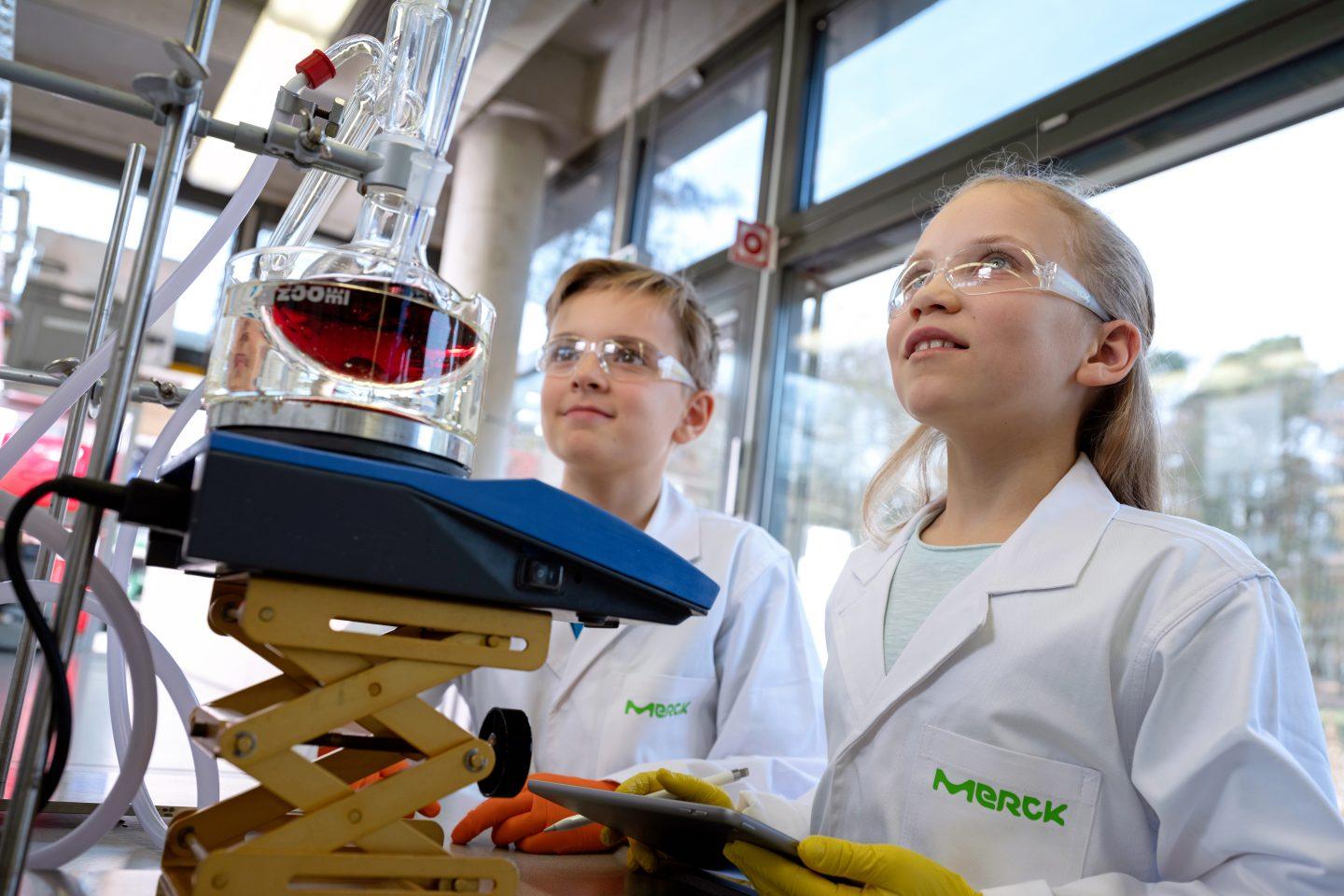
Youth Research 2026: Young talents inspire at Merck
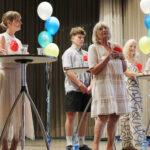
Darmstadt becomes a stage for young research talents every year: The best young scientists in Hesse regularly meet at Merck for the Hessian state competition of Jugend forscht (Young Researchers ). Around 75 participants presented their projects in seven subject areas in 2026 – from mathematics and computer science to technology, the world of work, biology and the environment.
This competition is the highest level at the state level: those who compete here have previously prevailed in one of the Hessian regional competitions. The standard is correspondingly high – and the range of topics is correspondingly broad.
Even during the tour through the exhibition, it became clear how diverse the ideas were: from robotics and autonomous mobility to applications of artificial intelligence and projects related to climate protection and sustainable energy.
“For me, it’s a wow moment every year,” says Maxi Nieber, mentoring coordinator at Merck. “I’m always impressed by the ideas the young people bring here – from robots to complex technical solutions. This range is extraordinary.”
Science knows no age
It is no coincidence that the competition is taking place in Darmstadt. The city is considered one of Germany's most important science hubs – with the Technical University of Darmstadt, Darmstadt University of Applied Sciences, research institutions such as the ESA and the GSI, and last but not least, Merck, a globally operating science and technology company.
“World-class researchers are working here – and now 75 young people are joining them,” says Nieber. “This shows that the spirit of inquiry knows no minimum age.”
For Merck, its involvement with Jugend forscht (Young Researchers) is more than just sponsorship. The company has been a partner of the competition for over 40 years and hosted the state competition for the 30th time in 2026.
“We support Jugend forscht with deep conviction,” says Maxi Nieber. “The young people here want to move the world forward. Curiosity breeds innovation – and that is exactly part of our company DNA.”
Creativity meets research
A look at the projects shows how much topics and methods have evolved. Artificial intelligence plays an increasingly important role – but no longer as an end in itself.
“A few years ago, AI itself was the research topic,” explains competition director Oliver Karplak. “Today, young people use it quite naturally as a tool and focus more on their own questions again.”
Sustainability, energy issues, and basic scientific research are also strongly represented. Unusual ideas and interdisciplinary approaches also characterize the competition.
This creativity never ceases to surprise even experienced observers.
“Young people often take completely different paths than established research,” says Karplak. “They don’t yet have this fixed framework – and that’s precisely why approaches sometimes emerge that no one had thought of before.”
Learning beyond the experiment
For the participants, Jugend forscht is much more than a competition. It is often their first intensive encounter with real scientific work – including all its challenges.
“A research project requires not only knowledge, but also perseverance,” says Karplak. “You have to stick with it, endure setbacks and keep working – that shapes young people a lot.”
Maxi Nieber also emphasizes this aspect:
"Young people learn to ask questions, to challenge things, and to think creatively. And they experience that failure is not the end – but often the beginning."
Exchange as a key
In addition to the projects themselves, personal exchange plays a key role. During the competition days, young researchers, the jury, companies, and the public come together to talk to each other.
“Exchange is perhaps the most valuable aspect here,” says Nieber. “The young people meet like-minded individuals, make contacts, and can present their ideas – on equal footing with experts.”
This often leads to new collaborations. Oliver Karplak recalls an example from a previous competition: Two participants worked independently on 3D scanning and 3D printing technologies – and together developed a new idea.
“Such encounters are something very special,” he says.
Impulses for the region
The state competition has an impact far beyond the event itself. It demonstrates the potential of the region – and can be crucial for educational and career paths.
“Here, young people experience research in a very concrete way,” says Nieber. “This can influence their choice of studies or their later career path.”
At the same time, companies and research institutions also benefit from direct contact with the talents of tomorrow.
A look into the future
The sight of these young researchers fills both participants with optimism. The topics they are working on are highly topical – from climate protection to digitalization.
“This generation is asking questions that we might not even be asking ourselves yet,” says Nieber. “And they will find answers to the challenges that concern us today.”
Karplak also observes a great passion among the participants:
"You can tell they are passionate about their topics. They want to understand, they want to shape things – and perhaps even change the world to some extent."
Courage to pursue your own idea
The message from those involved is clear: science does not begin in the laboratory, but with a question.
“Be brave, be creative, and dare to just get started,” says Nieber. “You don’t need a perfect setup – just curiosity and the willingness to stick with it.”
Karplak adds:
“At Jugend forscht, you can work on your own interests. You don't have to be a fully-fledged scientist – you just have to start.”
(RED)
Featured image: Photographic studio Eva Speith, Darmstadt
Liveable Darmstadt
powered by MerckClubs and associations are the heart of a community. They foster social integration and bring people together. They enrich local life through cultural and sporting activities, offer educational opportunities, and are involved in social projects. In short: they make a city like Darmstadt a great place to live.
But this costs money. Membership fees aren't always enough. In this series, we present selected Darmstadt clubs and associations that are supported by Merck – be it in sports, culture, community service, or science education.
Each of these clubs has a unique story and contributes to strengthening the community in its own way. We asked the organizers what makes their club special and how the partnership with Merck not only provides financial support but also fosters growth and development.
Learn more about the diverse club and association scene in Darmstadt and how Merck and its partners are achieving more together – for a region worth living in.