
The research building on the Lichtwiese meadow can disconnect from the power grid and supply itself with energy in case of a crisis
How can essential services continue to operate during a prolonged power outage in a city? This is one of the questions being addressed by the TU Darmstadt research project eHUB on the Lichtwiese campus. In the event of a power outage, the building can disconnect from the public grid and generate its own energy. During the first Hessian Resilience Week, Digital Minister Kristina Sinemus learned more about the project.
The eHUB uses electricity from a photovoltaic system, among other sources. Unlike many conventional photovoltaic systems, this system can continue operating during a public grid outage and switch to so-called island mode.
Power supply independent of the public grid
Conventional photovoltaic systems automatically shut down during a power outage for safety reasons if their inverters rely on an existing public power grid for operation. The eHUB, on the other hand, is designed to temporarily establish its own power grid.

If the building generates more energy than it consumes, some of it could be made available to other consumers in the vicinity or to critical infrastructure. According to those responsible for the project, it is also conceivable that such buildings could be used as contact points for the population in a crisis situation – for example, for energy supply and the dissemination of important information.
Digital Minister Kristina Sinemus sees this as an approach to keeping cities operational during prolonged power outages. The project combines digital control with renewable energy and could provide insights for protecting critical infrastructure.
From individual buildings to the emergency network
The eHUB was developed at the LOEWE Center emergenCITY at TU Darmstadt. Researchers there investigate how cities and their infrastructures can be better prepared for crises and prolonged outages.
The insights gained will now be increasingly translated into practical applications. The Digital Resilience Xchange (DiReX) application and transfer center.
Together with politicians, administrators, authorities, operators of critical infrastructures and scientists, DiReX is investigating how several decentralized energy sources could be connected to emergency networks in the event of a crisis.
This also addresses the question of who gets priority when energy is limited. The study examines, for example, how communication systems and other critical infrastructure can continue to operate, what criteria should be used to distribute energy, and what technical, legal, and social prerequisites are necessary.
Electricity for cell phone towers or traffic lights
One possible scenario is connecting several eHUBs to form a decentralized emergency network. According to the researchers, this network could, for example, supply power to cell phone towers or traffic lights.
“In a crisis, eHUBs could form decentralized emergency networks that supply power to, for example, cell phone towers or traffic lights,” explains Florian Steinke, Professor of Energy Information Networks and Systems at TU Darmstadt and researcher at the LOEWE Center emergenCITY. However, the necessary technical and regulatory prerequisites would first have to be established.
This is currently a research and testing concept and not an already available, comprehensive emergency power grid for Darmstadt.
The Hessian Ministry for Digital Affairs is funding DiReX from 2025 to 2027 with a total of approximately four million euros from state and EU funds. TU Darmstadt is contributing an additional one million euros of its own funds.
First Hessian Resilience Week
The visit took place as part of the first statewide Resilience Week in Hesse, which runs from September 7th to 13th, 2026. Through various events, the state aims to raise awareness of crisis preparedness and the resilience of the state, the economy, and society.
The Hessian Ministry for Digital Affairs is focusing in particular on digital infrastructures such as fixed-line networks, mobile communications, and data centers. This is due to potential disruptions caused by, among other things, extreme weather events, sabotage, or other crisis situations.
(DARMSTADT – RED/TUD)
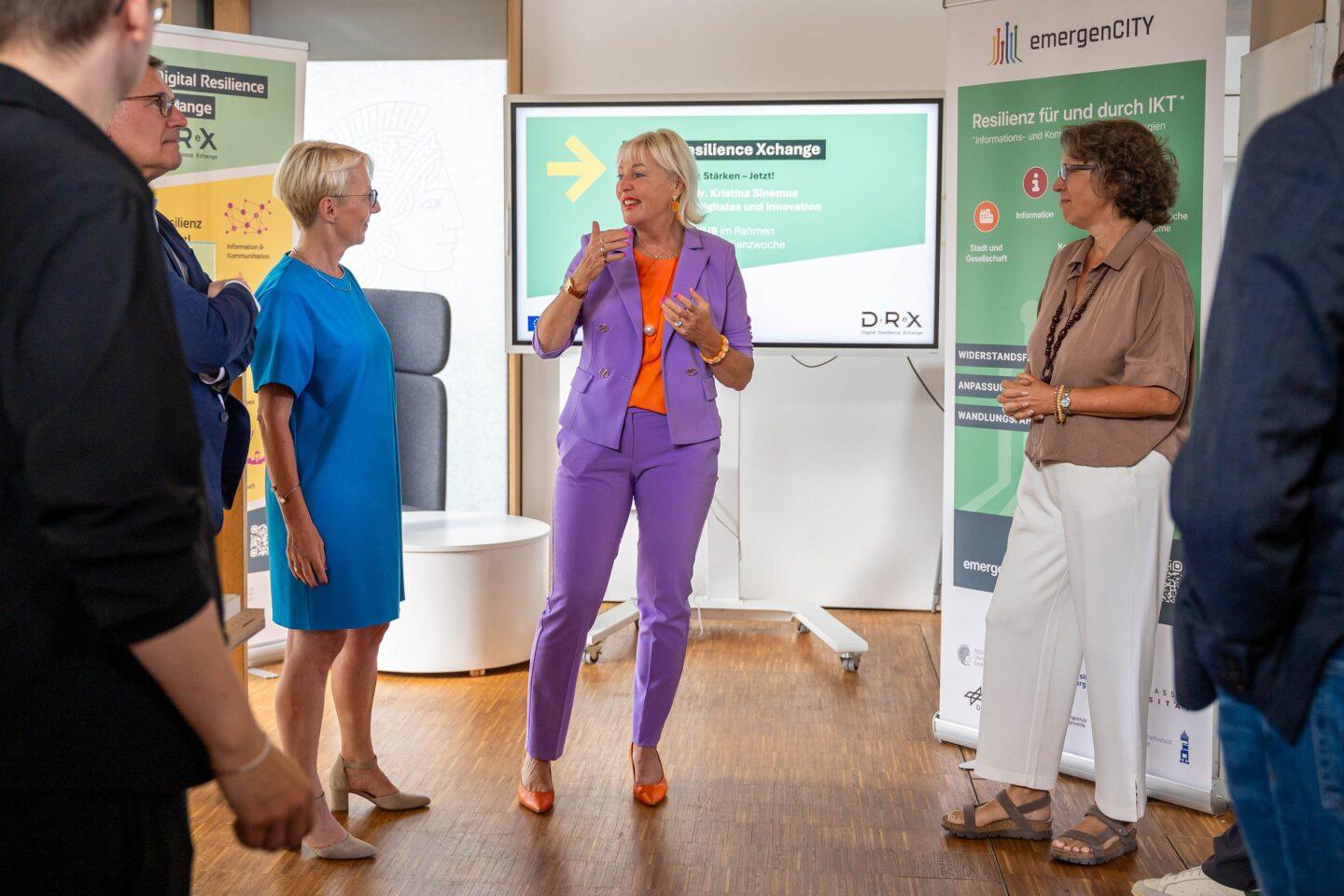
Featured image: Digital Minister Kristina Sinemus (center) exchanged ideas with TU President Tanja Brühl and Michèle Knodt, Director of the Application and Transfer Center Digital Resilience Xchange (DiReX), at the eHUB. Photo: DiReX/Adrian Noltemeier