


Record measurement at CRYRING@ESR opens opportunities for astrophysics
At the GSI Helmholtz Centre for Heavy Ion Research in the science city of Darmstadt, an international team has achieved a significant breakthrough in astrophysics. For the first time, nuclear reactions at extremely low energies were measured in the CRYRING@ESR storage ring – under conditions similar to those found in the interiors of stars.
Record at particularly low energies
Many nuclear processes in stars occur at very low energies. These so-called sub-MeV energies are difficult to replicate in the laboratory. At CRYRING@ESR, it has now been possible to lower the reaction energy to 403 kiloelectronvolts. This sets a new record: Never before has a nuclear reaction been measured at such a low energy in a heavy-ion storage ring.
The results were published in the journal The European Physical Journal A.

Complex technology enables new measurements
A key challenge was the short lifetime of the ion beams at low energies. However, the researchers were able to create stable measurement conditions through highly precise vacuum conditions and special cooling techniques.
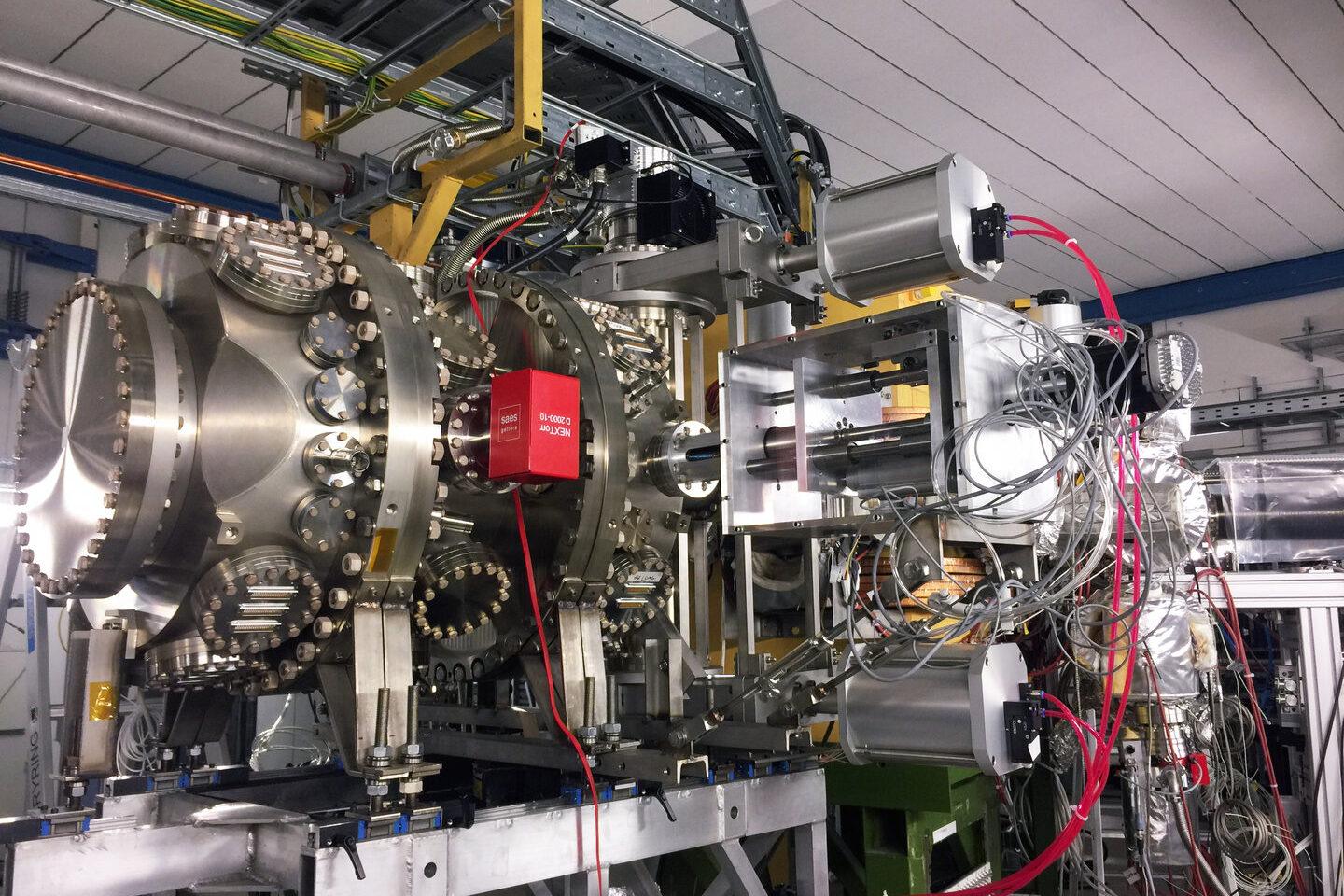
In the experiment, nitrogen ions were directed towards protons, among other things. The reactions took place in a cryogenic hydrogen gas target. The high-resolution CARME measurement system was used for the analysis. According to the research team, the data obtained agree very well with theoretical models.
New perspectives for astrophysics
This success is considered an important step in the study of the origin of elements in the universe. In the future, researchers also plan to investigate exotic atomic nuclei that play a central role in stellar processes.
Particular interest is focused on the so-called Big Bang nucleosynthesis – the processes by which the lighter elements were formed in the first minutes after the Big Bang. Researchers hope that the new experimental possibilities will provide more precise insights into these early phases of the universe.
(DARMSTADT – RED/GSI)
Featured image: CARME setup used for the experiments. Photo: GSI