

The SIBAF project aims to investigate new materials for future fusion power plants more quickly and efficiently
The GSI Helmholtz Centre for Heavy Ion Research and the FAIR International Accelerator Centre in Darmstadt are receiving substantial funding for fusion research. The Federal Ministry of Research, Technology and Space (BMFTR) is providing a total of €9.7 million over three years for the new SIBAF project. Of this, €8.1 million will go towards activities at GSI and FAIR.
SIBAF stands for "Superconducting Ion Accelerator as a Basic Technology for Fusion Research." Its goal is to build an accelerator-based infrastructure that will allow for the faster investigation and qualification of novel materials for future fusion power plants. The project is coordinated by GSI/FAIR, with Goethe University Frankfurt as another project partner.
Materials must withstand extreme conditions
One of the major technological challenges in the development of fusion power plants is finding suitable materials. They must withstand extremely high temperatures and intense neutron radiation over long periods.

Experiments with neutrons remain indispensable for research, but they are expensive and only possible at a few institutions worldwide. SIBAF complements this approach by irradiating materials with heavy ions. This allows radiation damage to be generated more quickly under precisely controlled conditions. At the same time, the activation of the samples under investigation is reduced, which facilitates subsequent analysis.
HELIAC accelerator is being further developed
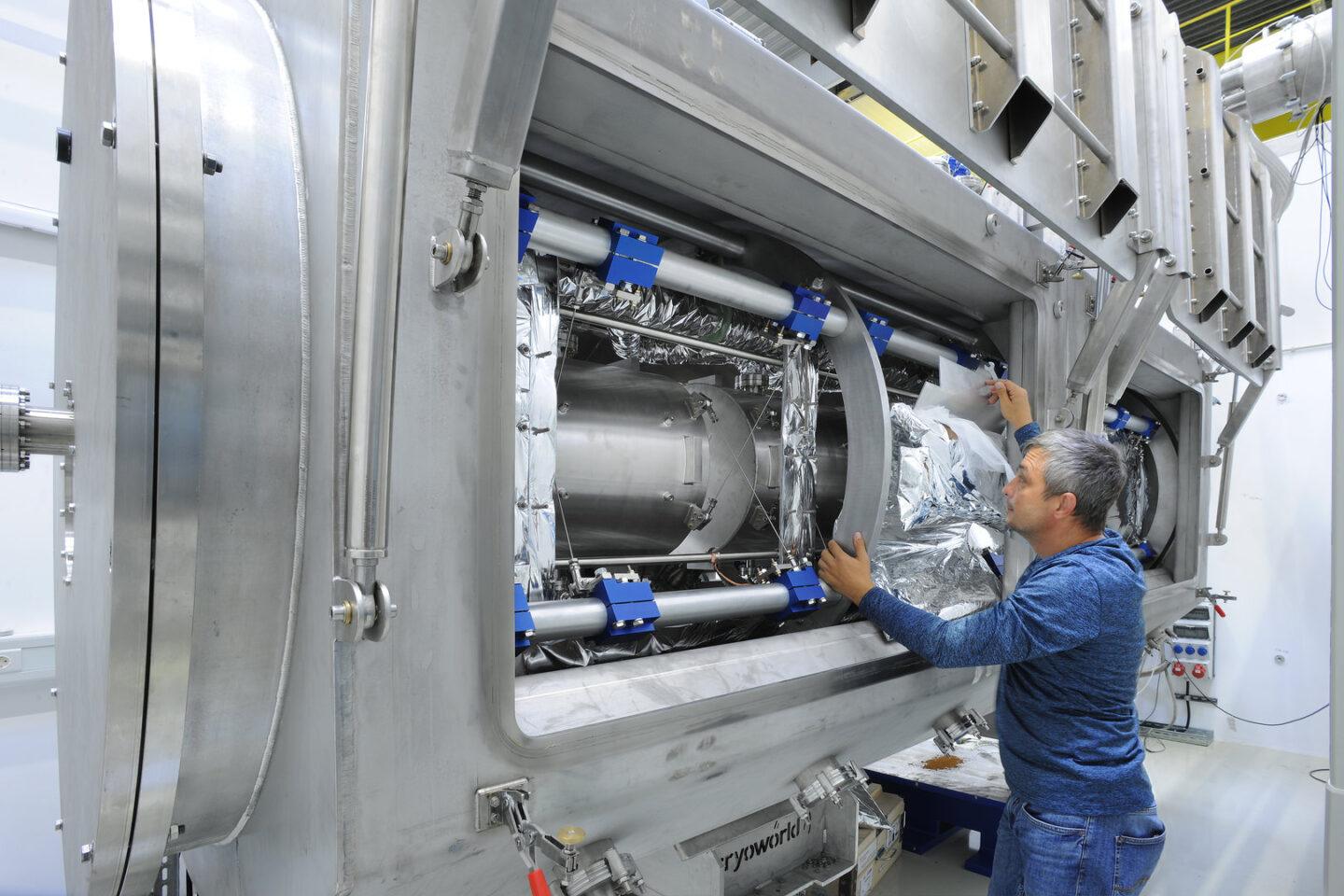
The superconducting continuous-wave accelerator HELIAC – the “Helmholtz Linear Accelerator” – will be further developed for these investigations. Parts of the accelerator are already being built on the GSI/FAIR campus.
A specialized irradiation system will be developed based on HELIAC's first cryomodule and the existing HLI high-charge injector. Features include temperature-controlled sample environments and automated sample handling.
The combination of superconducting accelerator technology and new methods for irradiation and material characterization should enable faster, more reproducible, and more energy-efficient investigation of potential fusion materials. Together, GSI/FAIR and Goethe University aim to develop HELIAC into a unique infrastructure for the qualification of fusion materials using ion beams, the only one of its kind in Europe.
“Practical applications” for accelerator technology
SIBAF is coordinated by Dr. Maksym Miski-Oglu, head of the cw-Linac research group at GSI/FAIR. "SIBAF will translate the expertise in superconducting linear accelerator technology, built up over many years, into practical applications," explains Miski-Oglu. These developments could thus directly support the search for suitable materials for future fusion power plants.
Professor María Eugenia Toimil-Molares, head of materials research, sees the new irradiation facility as an important addition to the existing research infrastructure. Continuous wave irradiation with heavy ions enables faster and better-controlled damage accumulation and can thus make a significant contribution to the qualification of new materials.
Significance for future energy technologies
For Professor Thomas Nilsson, Scientific Director of GSI and FAIR, the funding also demonstrates the increasing importance of Darmstadt's research for new energy technologies.
“SIBAF will significantly advance the development and qualification of materials for fusion applications while simultaneously offering excellent training opportunities for the next generation of scientistsand engineersin the fields of accelerator and fusion technologies,” said Nilsson. The project will also strengthen Germany’s contribution to international fusion research.
The consortium also acknowledges the contribution of Professor Winfried Barth to the conception, preparation and initial submission of the project proposal.
Part of the funding program “Fusion 2040”
SIBAF receives support under the funding guideline "Basic Technologies for Fusion – On the Way to a Fusion Power Plant". This funding supports key technologies needed for the construction and operation of future fusion power plants.
The guideline is part of the "Fusion 2040 – Research on the Path to a Fusion Power Plant" program. Its aim is to establish the scientific and technological foundations necessary for the construction and operation of the first fusion power plant in Germany. Fusion research is also a component of the German Federal Government's High-Tech Agenda Germany.
(DARMSTADT – RED/GSI)
Featured image: HELIAC's first cryomodule CM1: The superconducting solenoids and cavities are visible through the rectangular doors. Photo: GSI