



Research team presents non-destructive battery test
An international research team has developed a new method for non-destructively examining the condition of batteries. The GSI Helmholtz Centre for Heavy Ion Research in Darmstadt, via the Helmholtz Institute Mainz, was among the partners in the study. The results were published in the journal Chemical Science.
In addition to the Helmholtz Institute Mainz, the Johannes Gutenberg University Mainz, the Physikalisch-Technische Bundesanstalt in Berlin and the New York University were also involved in the research.
Battery problems often lie in the electrolyte
Rechargeable batteries – also known as accumulators – are indispensable in many areas today, such as smartphones, laptops, electric vehicles, and renewable energy storage. However, common causes of battery failure are changes in or loss of the electrolyte, the liquid inside the battery.

The electrolyte enables the transport of charged particles between the electrodes. During many charging cycles, its chemical composition can change, or it can leak. In unfavorable cases, this can lead to overheating or even explosions.
New diagnosis through nuclear magnetic resonance
Until now, reliable methods for checking the electrolyte's condition without opening the battery casing were lacking. This is precisely where the new research comes in.
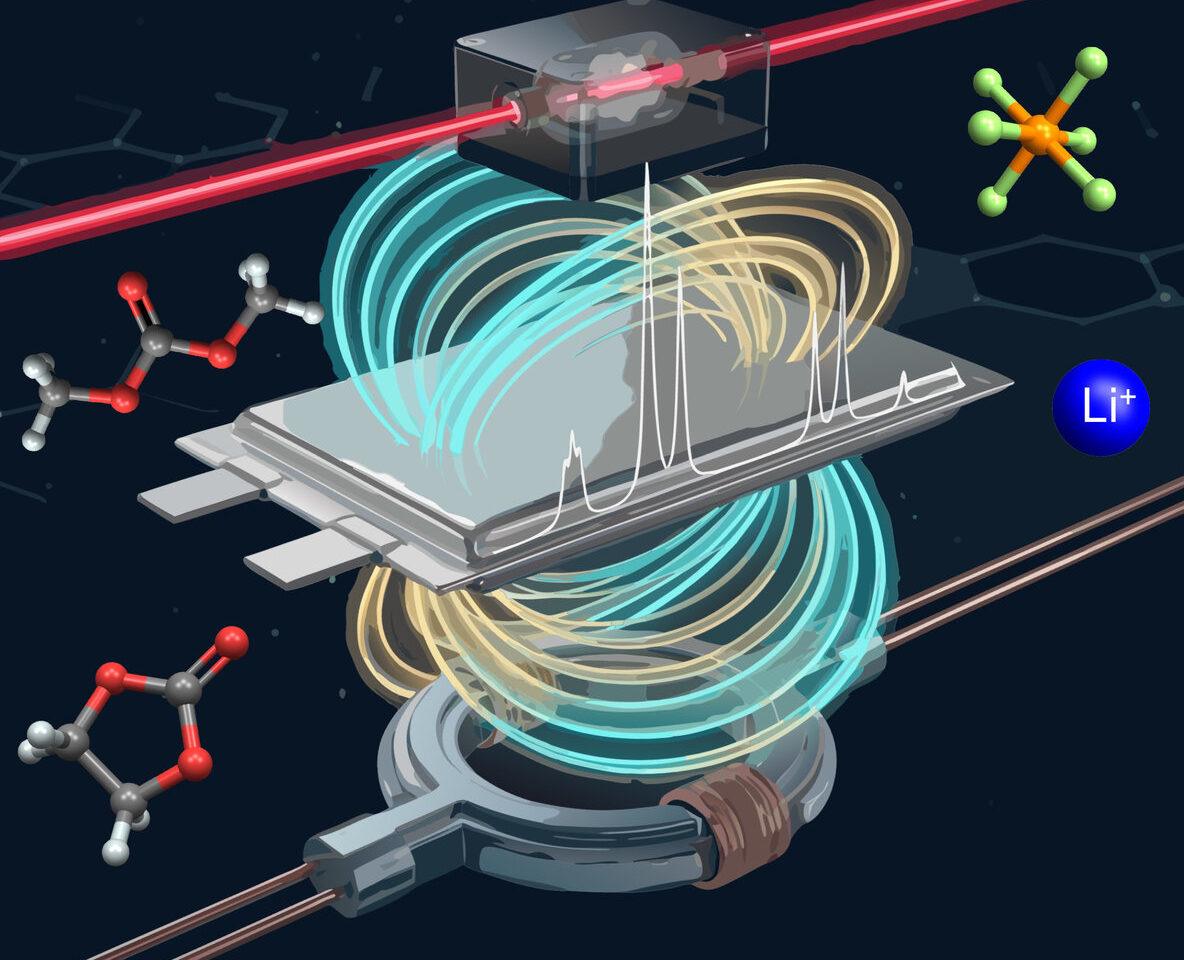
The scientists are using a special form of nuclear magnetic resonance called ZULF-NMR (Zero-to-Ultralow-Field Nuclear Magnetic Resonance). This technique measures magnetic resonance without a strong external magnetic field. Even the metal casings of batteries are permeable to this technique, making measurements inside them possible.
Using this method, the research team succeeded for the first time in detecting and quantifying both solvents and lithium salts in commercial battery electrolytes directly through the battery casing.
Perspectives for battery development
The new technology could be used in the future to monitor batteries during operation. Such so-called operando measurements would help to detect damage early and increase the lifespan of batteries.
Furthermore, the method could provide important insights into electrochemical processes and support the development of new battery technologies.
The research team is already planning further experiments to make the measurement methods faster, more precise, and more cost-effective. The goal is to establish non-destructive battery diagnostics as a complementary tool in research and industry in the future.
(DARMSTADT – RED/PM/GSI)
Featured image: ZULF-NMR measurement method Graphical representation of the ZULF-NMR measurement of a pouch cell (center) using quantum sensors such as optically pumped magnetometers (OPMs, top) and superconducting quantum interference devices (SQUIDs, bottom), which can detect and quantify the small magnetic fields generated by the nuclear spins of the molecules in the battery electrolyte.