
Municipal utility expands photovoltaic system to 350 square meters – investment expected to pay for itself in less than three years
The Groß-Gerau central wastewater treatment plant will produce even more of its own electricity in the future. The municipal utility company has installed another photovoltaic system on the roof of an operations building. It is expected to generate around 20,000 kilowatt-hours of electricity annually, thus contributing to the plant's energy supply. According to those responsible, the investment is not only ecologically sound but also economically viable: the costs should be recouped through energy savings in less than three years.
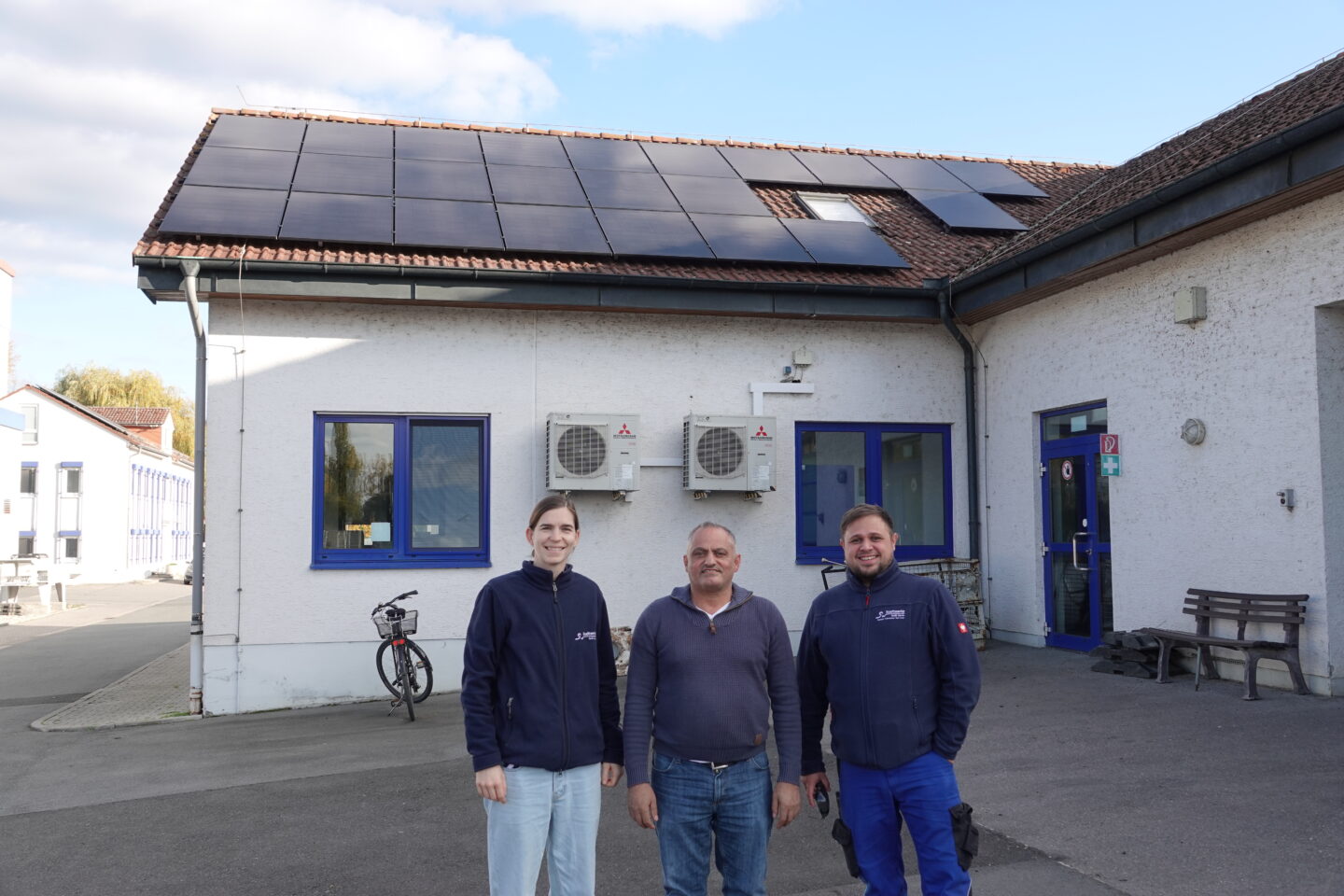
The new solar power system is located on the newer of the two operational buildings of the central wastewater treatment plant near the state road to Wallerstädten. The modules are oriented east-west and cover a roof area of approximately 100 square meters.
Electricity for six to seven four-person households
With an expected annual production of around 20,000 kilowatt hours, the new photovoltaic system could theoretically cover the average electricity needs of six to seven four-person households.

In fact, the energy generated is used to operate the wastewater treatment plant. Given the high electricity prices, the municipal utility expects a rapid return on investment.
“We recouped the investment in less than three years. The plant makes perfect sense from both an environmental and economic perspective,” explains wastewater treatment plant manager Georges Haddad.
The new system complements existing photovoltaic modules on the company premises. For several years now, a total of approximately 250 square meters of roof area on two company buildings has been equipped with solar modules. These generate about 27,000 kilowatt hours of electricity annually.
With the expansion, a total of approximately 350 square meters of photovoltaic surface area is now available. Annual electricity production thus increases to almost 50,000 kilowatt hours.
EU demands energy neutrality by 2045
The additional electricity generation is part of a broader strategy by which the municipal utility aims to reduce the energy consumption of its wastewater treatment plant and increase the share of renewable energies.
The background to this includes the requirements of the European Urban Wastewater Directive. This stipulates that by 2045, the wastewater industry should cover its energy needs entirely with renewable energy sources.
It is not necessary for each individual wastewater treatment plant to be energy-neutral. What is crucial is that the industry as a whole meets the relevant requirements.
Furthermore, the required energy does not have to be generated exclusively on the company's own premises. For example, investments in solar or wind farms are possible.
The European regulations stipulate several interim targets: By 2035, 40 percent of the required energy should come from renewable sources, and by 2040, this figure should reach 70 percent. The directive still needs to be transposed into national law.
The Groß-Gerau municipal utilities believe they are on the right track to meet these requirements.
Sewage gas supplies a large part of the self-generated energy
The annual electricity demand of the Groß-Gerau central sewage treatment plant is currently around 1.2 million kilowatt hours.
According to Harald Steiger, the technical operations manager of the municipal utilities, almost two-thirds of this is already generated in-house.
A key role is played by the combined heat and power plant (CHP) on the company premises. It uses the sewage gases produced during wastewater treatment to generate energy.
The combined heat and power plant has an electrical output of 125 kilowatts and a thermal output of 128 kilowatts.
This makes a significant contribution to covering the wastewater treatment plant's energy needs through its own production.
Although photovoltaic systems account for a significantly smaller share of total electricity consumption, they make a valuable addition to the energy supply.
Electricity consumption reduced by a quarter since 2013
In addition to generating their own energy, the municipal utilities are increasingly focusing on technical improvements to reduce electricity demand.
Significant successes are already evident.
In 2013, the central wastewater treatment plant required approximately 1.6 million kilowatt hours of electricity. Today, consumption is around 1.2 million kilowatt hours.
This corresponds to a saving of approximately 25 percent.
It is noteworthy that the wastewater treatment plant was expanded during this period and additional components were added. Taking these expansions into account, the municipal utility company believes the improvement in energy efficiency is even more significant.
“Every new pump we install runs more efficiently than the old ones,” explains Jasmin Werner, team leader of urban drainage.
One example is the blower station. According to the municipal utility company, electricity consumption there was reduced by about 40 percent.
Energy savings also affect fees
For the municipal utilities, improving energy efficiency is not solely a matter of climate protection.
Generating its own electricity and reducing energy consumption can also lower the ongoing operating costs of the wastewater treatment plant.
“We are doing a lot to make progress on the issue of energy neutrality. Smaller projects like the new photovoltaic system also help with this,” explains Harald Steiger.
He also points to the importance for the citizens: "And last but not least, self-generated energy and energy savings have a positive effect on fees. Ultimately, what we do is in the interest of the residents of Groß-Gerau."
With the new photovoltaic system, the municipal utility company is implementing another building block of its long-term energy and climate strategy.
Key figures at a glance
Location: Central wastewater treatment plant Groß-Gerau, near the state road to Wallerstädten
New photovoltaic system: Approximately 100 square meters of module area
Annual electricity production of the new plant: Approximately 20,000 kilowatt hours
Payback period: According to the municipal utilities, less than three years
Total photovoltaic area: Approximately 350 square meters
Total annual solar power production: Approximately 47,000 kilowatt hours
Annual electricity consumption of the wastewater treatment plant: Approximately 1.2 million kilowatt hours
On-site power generation: Almost two-thirds of electricity demand
Combined heat and power plant: 125 kilowatts of electrical and 128 kilowatts of thermal output
Electricity consumption in 2013: Approximately 1.6 million kilowatt hours
Electricity consumption today: Approximately 1.2 million kilowatt hours
Energy savings since 2013: Approximately 25 percent
EU target: Energy neutrality in wastewater management by 2045
(GROSS-GERAU – RED/PSGG)
Featured image: The new photovoltaic system on the roof of an operations building at the Groß-Gerau wastewater treatment plant generates approximately 20,000 kilowatt-hours (kWh) of electricity per year. Pictured (from left) are Jasmin Werner (Team Leader for Planning and Construction of Urban Drainage at the municipal utilities), wastewater treatment plant manager Georges Haddad, and his deputy, Timothy Reichert. Photo: City of Groß-Gerau/Jörg Monzheimer