More than 100 people learn about the future of the district heating network "Am Hohen Weg" – ENTEGA is considering taking over heat generation
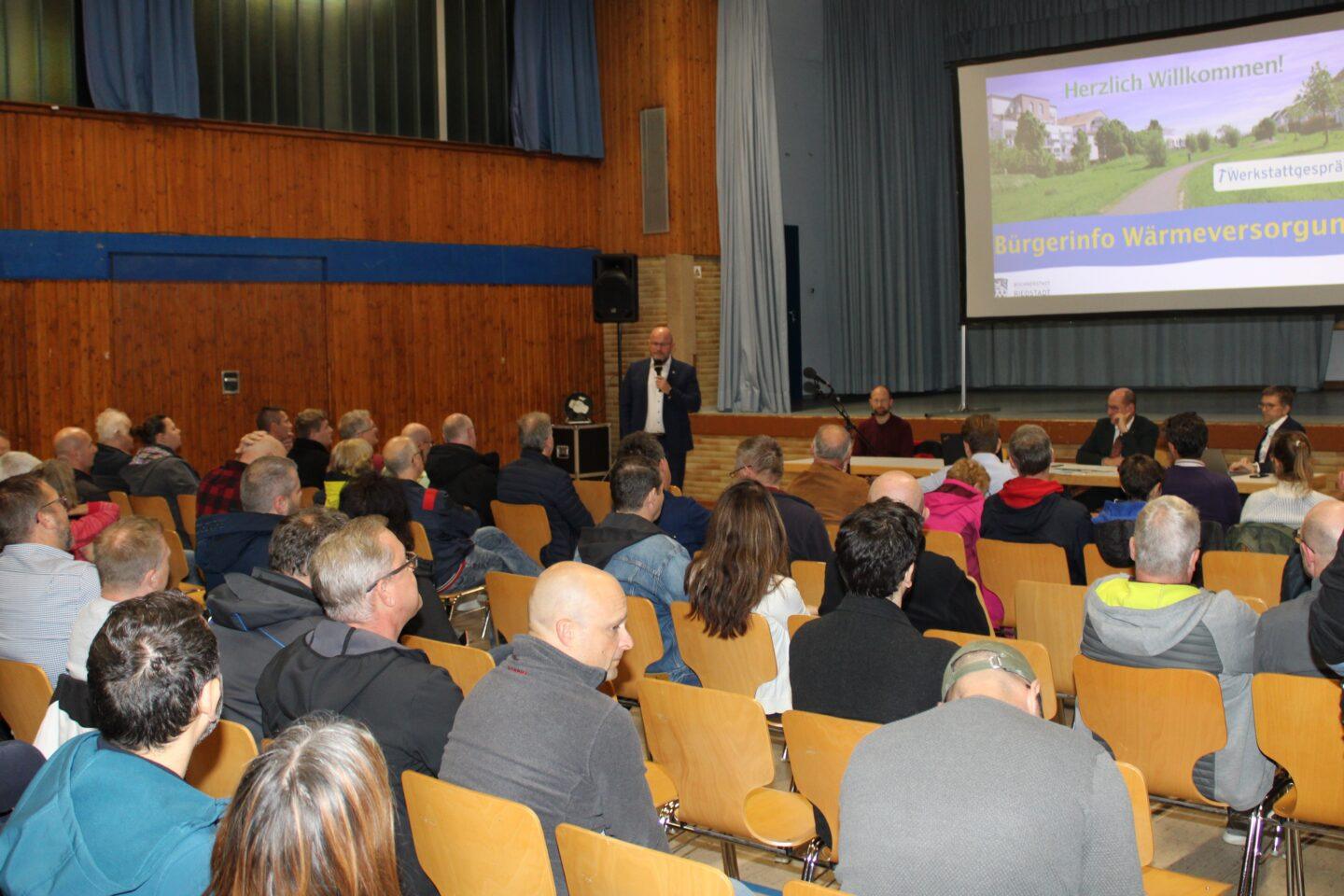
What will happen to the heat supply in the Riedstadt district of Goddelau? This question is currently on the minds of many residents of the "Am Hohen Weg" neighborhood. More than 100 people attended an information event held by the town of Riedstadt in the Christoph-Bär-Halle to learn about the planned restructuring of the heat supply. The background to this is the announcement by Vitos Südhessen that it will no longer produce heat for the neighborhood.
Mayor Marcus Kretschmann tried to allay the concerns of the residents right at the beginning: "No one will be left in the cold!" Together with representatives from Vitos Südhessen, ENTEGA and the city's redevelopment management, he explained the possible solutions and answered the citizens' questions.
Vitos wants to phase out heat generation
Currently, Vitos Südhessen produces the heat for the district. ENTEGA handles the distribution to the connected households via the existing district heating network.
This division of responsibilities could change in the future. Vitos Südhessen intends to discontinue its heat supply operations in order to focus more on its core business: operating the clinic. Managing Director Ralf Schulz explained this during the event.
The city's redevelopment manager, Benjamin Krick, presented the possibilities that arise from this for future supply.
One option would be for ENTEGA to take over not only the distribution but also the generation of heat in the future. Various models are conceivable: The supply could continue to cover both the neighborhood and Vitos, or be focused exclusively on the connected households.
ENTEGA could generate heat with heat pumps
According to Martin Freystein, Head of Heat at ENTEGA, the company would use an air-to-water heat pump if it were to take over the heat generation.
Where the corresponding plant could be built and whether it would also supply Vitos with heat in the future is still unclear.
ENTEGA is fundamentally interested in continuing to operate as a heat supplier in the future. However, it is also conceivable that another company could take over the supply.
Freystein explained that ENTEGA, as a commercially active company, was also prepared to negotiate a sale of the existing heating network, which had not yet been fully depreciated.
Decentralized heat pumps as an alternative
A fundamentally different option would be to switch to individual heat pumps in the buildings of the district.
According to renovation manager Benjamin Krick, the existing buildings on "Am Hohen Weg" offer favorable conditions for this. The houses have comparatively good thermal insulation, so decentralized heat pumps could be operated efficiently.
The comments made during the event made it clear that some owners would prefer this solution for economic reasons.
However, the disadvantages were also mentioned. Purchasing a heat pump would involve considerable individual investment. This could be overwhelming, especially for older or less financially secure homeowners. Such a conversion could also have negative economic consequences for landlords who do not live in their properties themselves.
Compulsory affiliation makes individual solutions more difficult
A key point of discussion was the existing obligation to connect to and use the district heating supply in the neighborhood.
This is regulated by a municipal ordinance and generally obligates the affected buildings to use the existing heating network for their heat supply. Other heat generators are currently not permitted. Exceptions exist for solar thermal systems and wood-burning stoves, as well as for buildings with extremely low heating requirements, such as passive house standards.
Several participants wanted to know why the city could not simply lift this obligation.
Mayor Marcus Kretschmann explained that this would reduce the amount of heat consumed via the district heating network. The operating costs of the network would then have to be distributed among fewer households.
“Then it will become more expensive for the remaining heat customers because they would have to bear the network costs alone,” Kretschmann explained.
This presents the city with the challenge of considering both economically viable solutions for the entire supply area and the interests of individual property owners.
Residents will be asked about their ideas
During the event, citizens were able to ask numerous questions and contribute their own ideas. Many had already submitted questions in advance, which were answered by representatives from the city, Vitos Südhessen, and ENTEGA.
It became clear that the future heat supply is not solely a technical issue. Long-term costs, the financial capacity of the owners, and the possibilities for individual solutions also play an important role.
Mayor Kretschmann finally took up a suggestion from the audience: The users in the "Am Hohen Weg" district should be asked about their ideas and possibilities regarding the future heat supply.
A final decision on the future care concept is still pending.
(RIEDSTADT – RED/PSR)
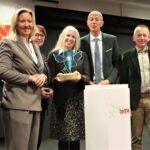
Featured image: The information event with Mayor Marcus Kretschmann (with microphone), renovation manager Benjamin Krick, Vitos South Hesse managing director Ralf Schulz, and Martin Freystein from ENTEGA (from left) was very well attended. Photo: City of Riedstadt