
Four historical tapestries can be seen together again after more than 50 years
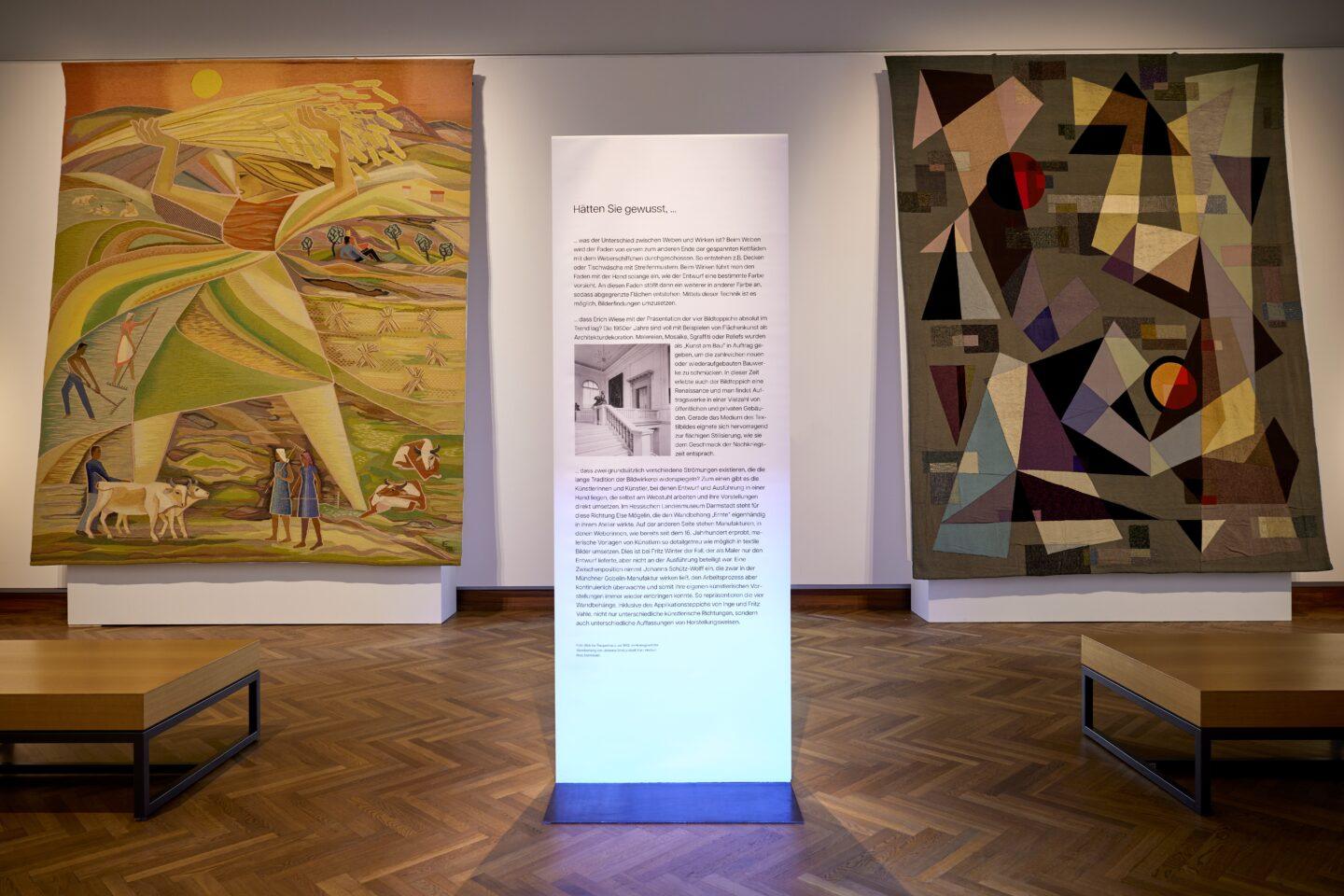
Four large-format tapestries, which introduced modern art to the Hessian State Museum Darmstadt in the 1950s, are the focus of the cabinet exhibition "Rediscovered! Textile Pictures for the Hessian State Museum Darmstadt". From July 9 to October 4, 2026, the works will be presented together for the first time in more than five decades.
The exhibition in the skylit hall not only displays the four tapestries, but also the surviving design drawings. This reveals a special chapter in the history of the Darmstadt Museum and, at the same time, provides insight into textile art of the post-war period.
The works originated during the reconstruction phase of the Hessian State Museum in Darmstadt after the Second World War. In 1954, as the renovation work on the severely damaged museum building was nearing completion, the then museum director, Erich Wiese, conceived the idea of furnishing the main staircase with contemporary textile art.

Four artistic positions were to showcase the diversity of tapestry art at that time: two more representational and two abstract approaches. The renowned textile artists Else Mögelin and Johanna Schütz-Wolff, as well as Fritz and Inge Vahle and Fritz Winter, were commissioned.
A piece of museum history returns
The tapestries were designed in 1955 and completed in 1956. However, due to delays in the renovation work, they could not be displayed in the main stairwell until 1958. There, the figurative and abstract works formed deliberately placed artistic contrasts and represented the creative range of modern textile art.
“This presentation offers a rare opportunity: For the first time in over fifty years, all four tapestries can be seen together again,” explains curator Dr. Wolfgang Glüber, head of the decorative arts collection at the Hessian State Museum Darmstadt. The reunification of the works and their design drawings “not only brings a significant chapter of the museum’s history to life, but also offers a unique insight into post-war textile art.”.
For Glüber, the exhibition also has a personal significance: After 30 years of work at the Hessian State Museum Darmstadt, the head of the arts and crafts collection is retiring with this presentation.
Bauhaus, abstraction and textile art
The participating artists represent diverse developments in modern art. Else Mögelin studied under Johannes Itten, Paul Klee, and Gerhard Marcks at the Bauhaus in Weimar, among others, and later, as head of the textile workshop at the Stettin School of Applied Arts, significantly shaped textile art.
Johanna Schütz-Wolff, as head of the textile class and hand weaving at Burg Giebichenstein, influenced numerous generations of artists and is one of the important representatives of graphic and textile art of the 20th century.
The Darmstadt-based artists Fritz and Inge Vahle created numerous abstract wall hangings in addition to graphic and painted works. Fritz Winter, in turn, is considered one of the most important German artists of the post-war period and a pioneer of European abstraction. Textile works are a notable exception in his oeuvre.
Exhibition “Rediscovered! Textile Pictures for the Hessian State Museum Darmstadt”
Dates: July 9 to October 4, 2026
Location: Skylight Hall, Hessian State Museum Darmstadt
Curator: Dr. Wolfgang Glüber
(DARMSTADT – RED/HLMD)
Featured image: View of the presentation "Rediscovered!" with wall hanging "Harvest" by Else Mögelin and appliquéd carpet by Ingeborg Vahle-Giessler and Fritz Vahle, photo L. Breidert, HLMD © VG Bild-Kunst